BOOX Go 6: Specs, Features, Pros & Cons
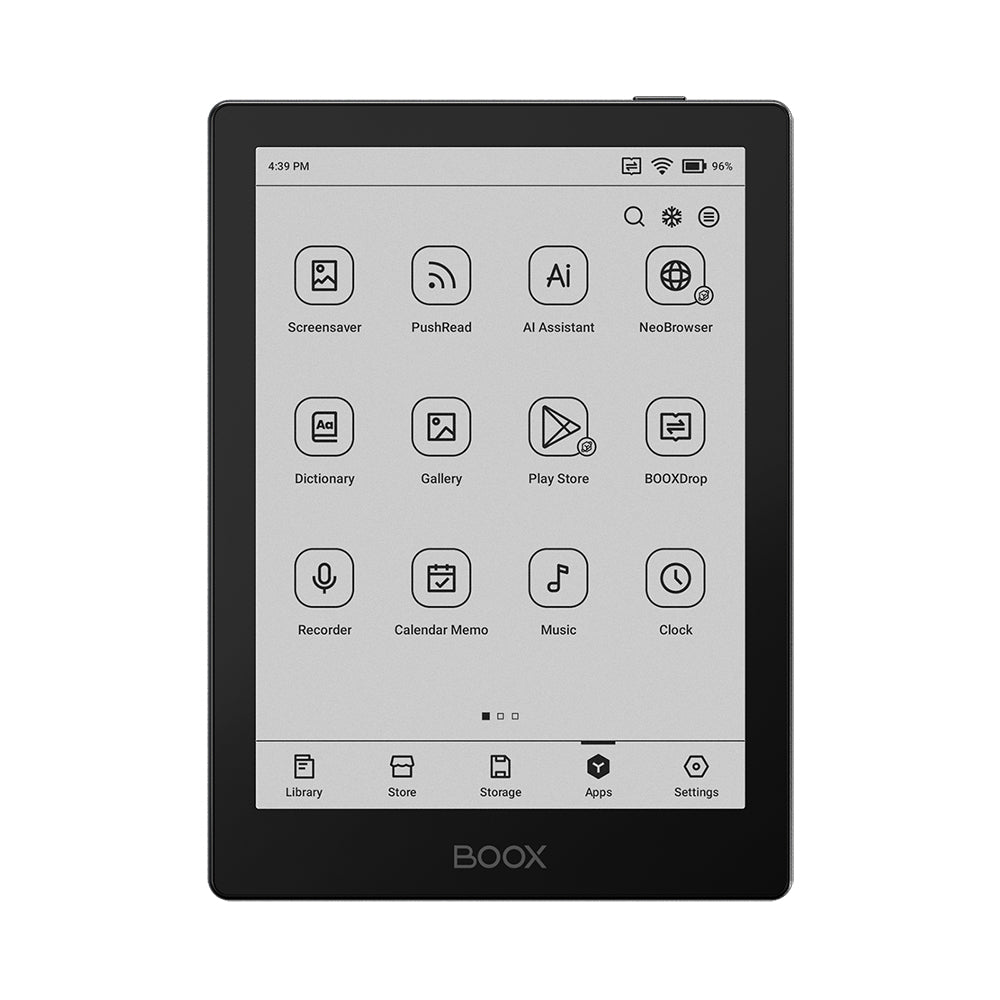
Onyx's smallest reader is also its most unusual: a 6-inch e-ink device running full Android with the Google Play Store on it, in a size class almost every other maker treats as the locked-down entry tier. Kindle and Kobo sell readers this size as closed appliances tied to one bookstore. The Go 6 sells the same footprint as a general-purpose device you can put Libby, a Kindle app, a DRM-free EPUB reader and a podcast client on at the same time.
That openness is the whole proposition, and it is worth being clear about what it costs and what it does not. The Carta 1300 panel is current-generation monochrome e-ink, sharp at the 300 ppi that has been the readable standard for a decade, and it sits flush under a glass cover lens. The body is thin enough to disappear into a coat pocket and light enough to hold one-handed for an hour without noticing. A microSD slot survives here, which Amazon and Kobo both abandoned years ago.
What it gives up is more telling than what it has. Onyx's own hardware list names a single power button, so every page turn is a tap or a swipe on the glass. There is a microphone in that list and no speaker, so audiobooks mean Bluetooth headphones or a USB-C dongle. And there is no ingress-protection rating printed anywhere on the specification sheet, which matters more than people expect for a device that ends up in bathrooms and on beaches.
It is priced above the mainstream small readers. You are paying for an app platform, not for a better reading screen. If every book you read comes from one store, the premium buys you nothing you will ever use.
Category strengths
Where the BOOX Go 6 beats the average
- A lighter build ?146 g vs 175 g (avg)
Where the BOOX Go 6 trails the average
- No color display ?
- No page-turn buttons ?
- Much less storage ?32 GB vs 64 GB (avg)
- A smaller battery ?1,500 mAh vs 2,300 mAh (avg)
- Much less RAM ?2 GB vs 4 GB (avg)
- Lower resolution ?1,448 px vs 1,648 px (avg)
- A slightly smaller screen ?6" (15.24 cm) vs 6.13" (15.57 cm) (avg)
- A slightly thicker body ?6.8 mm vs 6.7 mm (avg)
How this VS Score was computed
Score 40: each known spec is measured against the median of Android e-readers (7 products, medians winsorised to the 10th–90th percentile), then weighted. 43% of the scoreable weight could be used; unknown values, features not applicable to this class and proxies (battery capacity where a rated life exists) add or remove nothing.
| Specification | This product | Cohort median | Score weight | Points moved |
|---|---|---|---|---|
| Color display | No | 57% of the class have it | 0.5 | −24.0 |
| Page-turn buttons | No | 80% of the class have it | 0.5 | −24.0 |
| Weight | 146 | 175 | 2 | +20.0 |
| Internal storage | 32 | 64 | 0.7 | −17.5 |
| Battery capacity | 1,500 | 2,300 | 1 | −17.0 |
| RAM | 2 | 4 | 0.5 | −12.5 |
| Cellular | No | 43% of the class have it | 0.2 | −9.6 |
| Screen size | 6 | 6.13 | 1 | −1.0 |
| Thickness | 6.8 | 6.7 | 0.5 | −0.5 |
| Pixel density | 300 | 300 | 2 | +0.0 |
Not scored: Resolution (one resolution dimension is not a sharpness measure; pixel density is scored instead); Front light (standard for the class (100% have it)); Adjustable warm light (standard for the class (86% have it)); Auto-brightness (unknown: not scored); Flush screen (standard for the class (100% have it)); Dark mode (standard for the class (100% have it)); Touchscreen (standard for the class (100% have it)); Stylus support (unknown: not scored); EPUB support (standard for the class (100% have it)); Audiobook support (standard for the class (100% have it)); Text-to-speech (unknown: not scored); Library lending (unknown: not scored); Cloud sync (standard for the class (100% have it)); App store (standard for the class (100% have it)); Expandable storage (microSD) (standard for the class (100% have it)); Battery life (weeks) (unknown: not scored); Charge time (unknown: not scored); USB-C (standard for the class (100% have it)); Wireless charging (unknown: not scored); Bluetooth (standard for the class (100% have it)); Speakers (unknown: not scored); 3.5mm headphone jack (not applicable: only 0% of this class have it); Waterproof (unknown: not scored).
Editor’s note
The thing I keep circling back to with the Go 6 is that it solves a problem most buyers in this size class do not have. Open Android on an e-reader is useful when your library is scattered – a few purchases locked to one store, library loans through Libby, a pile of loose EPUBs, maybe a read-later queue. If that describes your shelf, this is one of very few small readers that handles all of it without sideloading gymnastics, and Onyx ships Play Store access preinstalled, so there is no hunting for an APK.
If it does not describe your shelf, the case comes apart fast. Onyx's Android build is not why anyone buys BOOX. It is already a release or two behind when a device ships, updates land on Onyx's schedule, and apps written for bright 60 Hz LCDs behave exactly as you would expect on a slow monochrome panel. Each one has to be tuned by hand in BOOX's per-app optimisation menu, which works but is fiddly and is not something a Kindle owner will enjoy discovering.
The memory allocation is the part that would make me hesitate. Two gigabytes is enough for a reader app and very little else, and running a store app, a sync service and a browser together is precisely the workload that exposes it. The seven-inch model in the same family carries twice that and a bigger cell for not a great deal more money.
Value is reasonable rather than good. Against a Paperwhite or a Clara you are paying extra for flexibility and accepting rougher software and no water protection in return. Buy it because you want a small open device. Do not buy it expecting the best small reading experience, because that is not what the money is going towards.
Specifications
Quality bars are generated automatically against 12 other e-readers.
Display
Reading
Storage & performance
Battery
Connectivity
Design
Sources and verification
Where the specifications come from
- Official product pageshop.boox.com
Verification
- First published
- Specifications last checked
- Sheet completeness
- 28 of 39 specifications verified; the rest show as Unknown and are never estimated or scored
- Page type
- Product specification page — Compiled from the manufacturer’s published specifications and the cited sources; this is not a hands-on test.
- Basis
- Research-based: specifications and editorial text were compiled from the documents listed here and the manufacturer’s published data. We have not tested this unit ourselves; where independent measurements are mentioned they belong to the linked publication.
E-Readers with similar specs to the BOOX Go 6
Ratings & reviews
No reviews yet. Be the first to share your experience.
The bottom line
The BOOX Go 6 earns a VS Score of 40, trailing most of the 13 e-readers we compare here, at least on the spec sheet.
- Who it’s for
- Readers whose library is split across several stores and formats – a few locked purchases, library loans, loose EPUBs – who want all of it on one device that fits in a coat pocket.
- Who should look elsewhere
- Anyone who buys every book from a single store. A Kindle or a Kobo does that job better, for less, and with water protection this does not offer.
- The trade-off that matters
- You swap polished, purpose-built reader software for an open app platform, and on a slow monochrome panel that openness costs you speed and a lot of per-app fiddling.
- The main alternative
- BOOX Go 7 – the same open Android approach with more memory, a bigger battery and physical page-turn buttons, if you can live with a larger body.
The VS Score is calculated from the weighted specifications above, compared with every other e-reader we track — a shortlisting guide, not a substitute for your own priorities. See how we score.