Viwoods AiPaper Reader C: Specs, Features, Pros & Cons
Viwoods is unusually candid about what its colour model gives up. In the company's own side-by-side chart, the row comparing the two Readers with the front light switched off reads Brighter for the monochrome version and Darker for this one. That is the Kaleido 3 bargain in a single word, and most brands take some trouble to bury it.
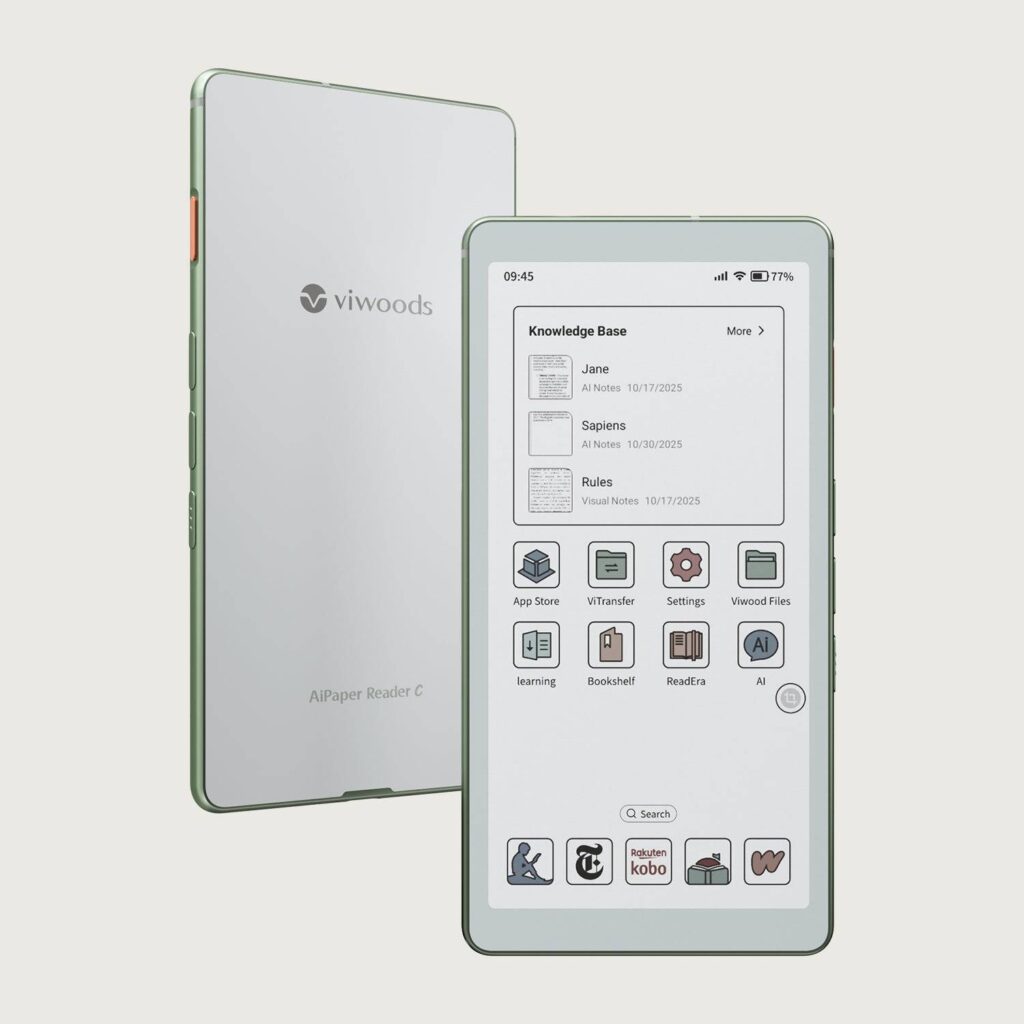
The rest of the hardware is the monochrome Reader's: the same aluminium shell, the same SIM tray for mobile data, the same Android 16 base and the same dedicated AI key on the side. What changes is the panel. Colour arrives at 150 ppi, a quarter of the pixels the black-and-white text layer gets, so covers, chart colours and comic panels read as tinted rather than vivid. Text stays crisp, because text is still drawn on the finer monochrome grid underneath.
In exchange for the darker screen this one gains a dual front light with both cool and warm settings, which its sibling does not offer at all. For night reading that is a useful swap, and it partly pays back what the filter layer takes away.
So who is it for? Someone whose reading is not mostly novels – textbooks with colour-coded diagrams, technical documents, manga, magazines – and who would rather have muted colour than none at all. Anyone reading straight prose should take the monochrome version and keep the brighter unlit screen.
The deeper caveat is shared with its sibling: no speaker, no headphone jack, and no stylus support despite the AiPaper name. This is a small connected reader with a colour filter over it, not a compact tablet, and it works best for people who accept that framing before they buy.
Category strengths
Where the Viwoods AiPaper Reader C beats the average
- Much more storage ?128 GB vs 64 GB (avg)
- A lighter build ?140 g vs 175 g (avg)
- Has cellular ?
Where the Viwoods AiPaper Reader C trails the average
- No stylus support ?
- No speakers ?
How this VS Score was computed
Score 60: each known spec is measured against the median of Android e-readers (7 products, medians winsorised to the 10th–90th percentile), then weighted. 29% of the scoreable weight could be used; unknown values, features not applicable to this class and proxies (battery capacity where a rated life exists) add or remove nothing.
| Specification | This product | Cohort median | Score weight | Points moved |
|---|---|---|---|---|
| Internal storage | 128 | 64 | 0.7 | +35.0 |
| Weight | 140 | 175 | 2 | +26.0 |
| Color display | Yes | 57% of the class have it | 0.5 | +25.0 |
| Stylus support | No | 50% of the class have it | 0.5 | −24.0 |
| Cellular | Yes | 43% of the class have it | 0.2 | +10.0 |
| Speakers | No | 67% of the class have it | 0.2 | −9.6 |
| Screen size | 6.13 | 6.13 | 1 | +0.0 |
| RAM | 4 | 4 | 0.5 | +0.0 |
| Thickness | 6.7 | 6.7 | 0.5 | +0.0 |
Not scored: Resolution (one resolution dimension is not a sharpness measure; pixel density is scored instead); Pixel density (unknown: not scored); Front light (standard for the class (100% have it)); Adjustable warm light (standard for the class (86% have it)); Auto-brightness (unknown: not scored); Flush screen (unknown: not scored); Dark mode (unknown: not scored); Touchscreen (standard for the class (100% have it)); Page-turn buttons (unknown: not scored); EPUB support (standard for the class (100% have it)); Audiobook support (standard for the class (100% have it)); Text-to-speech (unknown: not scored); Library lending (unknown: not scored); Cloud sync (standard for the class (100% have it)); App store (standard for the class (100% have it)); Expandable storage (microSD) (unknown: not scored); Battery capacity (capacity is a proxy; the rated battery life is scored instead); Battery life (weeks) (too few comparable peers (2, need 3)); Charge time (unknown: not scored); USB-C (standard for the class (100% have it)); Wireless charging (unknown: not scored); Bluetooth (standard for the class (100% have it)); 3.5mm headphone jack (unknown: not scored); Waterproof (unknown: not scored).
Editor’s note
Kaleido 3 has been shipping in products for long enough that its limits are well understood, and the useful thing about this particular implementation is how clearly the maker states them. The colour filter sits over the monochrome layer, so it steals light, and Viwoods' own chart concedes that the unlit screen is darker than its sibling's. Almost everything about whether to buy this device follows from deciding whether that is acceptable to you.
For the right content it clearly is. Colour-coded study notes, wiring diagrams, chemical structures, manga where tone carries meaning – all of these are easier to follow with even muted colour than without it. For a novel, colour does nothing at all and the contrast loss is a tax you pay on every page.
The dual front light is the underrated half of the swap. Warm lighting on a small reader is the difference between reading comfortably in bed and giving up on the idea, and the monochrome model does not have it. At 140 g and 128 GB with the same cellular radio, the physical package is otherwise unchanged, which makes this a pure display decision.
What I would want a buyer to understand is the ceiling. This is a pocket-class reader with a colour filter, an AI button and no speaker. It is not a note-taker, it is not a tablet, and nothing about the silicon suggests it will handle a dense colour PDF gracefully – Viwoods has been honest about the display and much vaguer about that.
If colour is a nice-to-have, take the monochrome Reader. If colour is the actual reason you are shopping, this is a sensible way to get it into a pocket.
Specifications
Quality bars are generated automatically against 12 other e-readers.
Display
Reading
Storage & performance
Battery
Connectivity
Design
Sources and verification
Where the specifications come from
- Official product pageviwoods.com
- Datasheet or manualviwoods.com
Verification
- First published
- Specifications last checked
- Sheet completeness
- 25 of 39 specifications verified; the rest show as Unknown and are never estimated or scored
- Page type
- Product specification page — Compiled from the manufacturer’s published specifications and the cited sources; this is not a hands-on test.
- Basis
- Research-based: specifications and editorial text were compiled from the documents listed here and the manufacturer’s published data. We have not tested this unit ourselves; where independent measurements are mentioned they belong to the linked publication.
E-Readers with similar specs to the Viwoods AiPaper Reader C
Ratings & reviews
No reviews yet. Be the first to share your experience.
The bottom line
The Viwoods AiPaper Reader C earns a VS Score of 60 on the 29% of specifications we could compare like for like — an indication, not a ranking.
- Who it’s for
- Someone reading textbooks, manga or illustrated non-fiction on a device that fits in a pocket, who wants colour enough to accept a dimmer panel for it.
- Who should look elsewhere
- Prose readers – the filter costs contrast you will notice on every page, and the monochrome Reader is brighter and cheaper for exactly the same books.
- The trade-off that matters
- Colour and a warm-capable light arrive together, and both are paid for with an unlit screen the maker itself describes as darker than its sibling's.
- The main alternative
- BOOX Go Color 7 offers a larger Kaleido 3 panel and a more mature app ecosystem, if fitting in a pocket is not the thing deciding it for you.
The VS Score is calculated from the weighted specifications above, compared with every other e-reader we track — a shortlisting guide, not a substitute for your own priorities. See how we score.