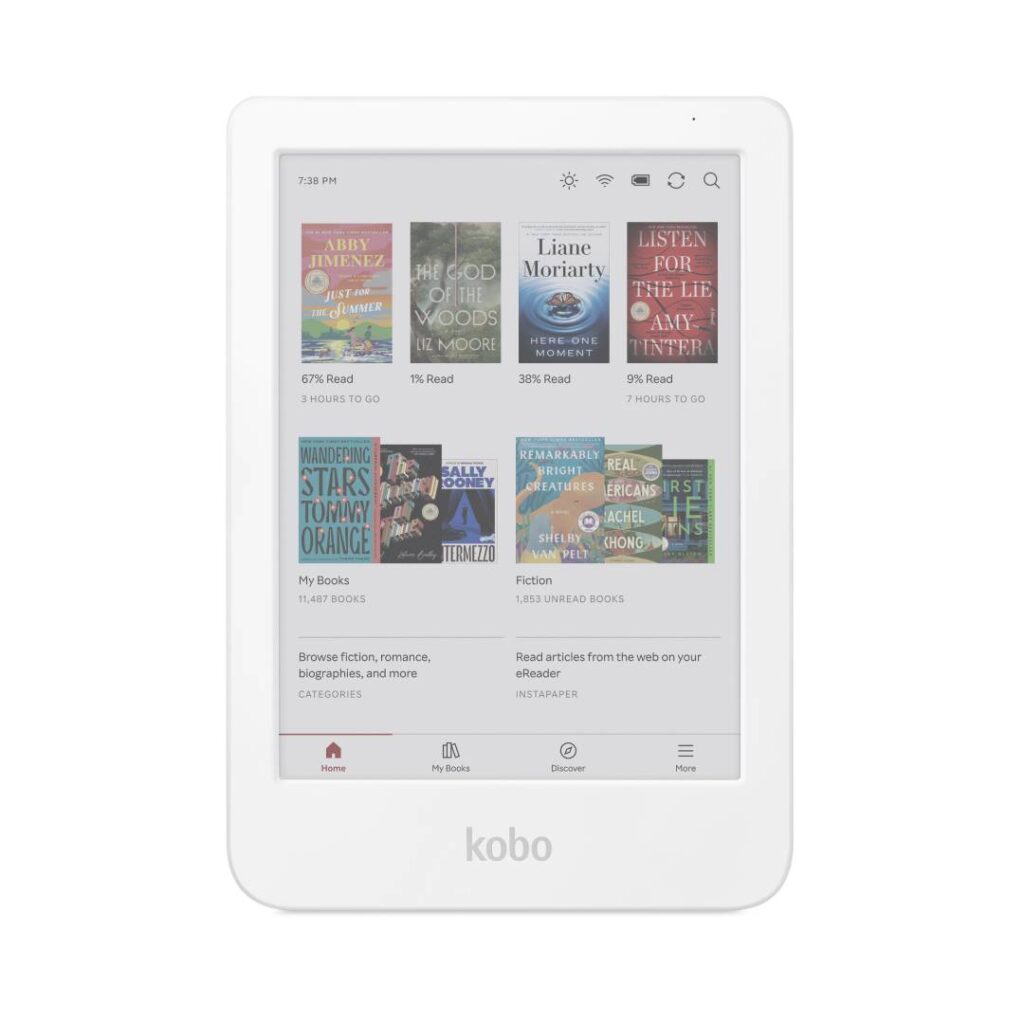
Kobo Clara Colour: Specs, Price, Pros & Cons
Kobo put the word Colour in the name and then, to its credit, published the number that undercuts it. The Kaleido 3 layer on this six-inch panel renders colour at half the density of the black-and-white text underneath it, and that single fact explains most of what the device is. Prose looks exactly as sharp as it does on a monochrome reader. Cover art, comic panels and colour-coded study notes look softer and more washed out than the marketing photography suggests.
Whether that trade is worth taking depends entirely on what you open. Someone reading novels gets colour they will barely notice and pays for it in contrast, because the filter layer sits over the screen whether or not anything on the page is coloured. Someone annotating textbooks, working through graphic novels or caring about seeing a cover the way the designer drew it gets something a monochrome reader cannot do.
Around that panel is the smallest waterproof reader Kobo currently sells and the most portable one in its colour range. It takes a dunking, it holds a library that will outlast the hardware, and it charges over USB-C. Library borrowing through Libby is built in rather than bolted on, which still separates Kobo from the obvious alternative.
The omissions deserve to be known before the spec table. There are no physical page-turn buttons, so every page is a tap on the glass. Kobo reserves stylus support for the larger models, so this one has none at all. There is no memory card slot either. And although the device plays audiobooks, it has no speaker and no headphone socket, so a Bluetooth headset is not an accessory here, it is the only way to hear anything at all.
Category strengths
Where the Kobo Clara Colour beats the average
- Has color display ?
- Has waterproof ?
- A slightly lighter build ?174 g vs 175 g (avg)
Where the Kobo Clara Colour trails the average
- No page-turn buttons ?
- Much less storage ?16 GB vs 32 GB (avg)
- Lower resolution ?1,448 px vs 1,648 px (avg)
- A thicker body ?9.2 mm vs 7.6 mm (avg)
- A slightly smaller screen ?6" (15.24 cm) vs 6.13" (15.57 cm) (avg)
How this VS Score was computed
Score 50: each known spec is measured against the median of all e-readers (13 products, medians winsorised to the 10th–90th percentile), then weighted. 49% of the scoreable weight could be used; unknown values, features not applicable to this class and proxies (battery capacity where a rated life exists) add or remove nothing.
| Specification | This product | Cohort median | Score weight | Points moved |
|---|---|---|---|---|
| Waterproof | Yes | 50% of the class have it | 1 | +50.0 |
| Color display | Yes | 46% of the class have it | 0.5 | +25.0 |
| Page-turn buttons | No | 60% of the class have it | 0.5 | −24.0 |
| Internal storage | 16 | 32 | 0.5 | −12.5 |
| Stylus support | No | 42% of the class have it | 0.25 | −12.0 |
| Cellular | No | 23% of the class have it | 0.2 | −9.6 |
| Speakers | No | 33% of the class have it | 0.2 | −9.6 |
| Thickness | 9.2 | 7.6 | 0.5 | −3.5 |
| Screen size | 6 | 6.13 | 1 | −1.0 |
| Pixel density | 300 | 300 | 2 | +0.0 |
| Battery life (weeks) | 6 | 6 | 1.5 | +0.0 |
| Weight | 174 | 175 | 2 | +0.0 |
Not scored: Resolution (one resolution dimension is not a sharpness measure; pixel density is scored instead); Front light (standard for the class (100% have it)); Adjustable warm light (standard for the class (85% have it)); Auto-brightness (unknown: not scored); Flush screen (unknown: not scored); Dark mode (standard for the class (100% have it)); Touchscreen (standard for the class (100% have it)); EPUB support (standard for the class (85% have it)); Audiobook support (standard for the class (100% have it)); Text-to-speech (unknown: not scored); Library lending (standard for the class (100% have it)); Cloud sync (unknown: not scored); App store (unknown: not scored); Expandable storage (microSD) (unknown: not scored); RAM (unknown: not scored); Battery capacity (unknown: not scored); Charge time (unknown: not scored); USB-C (standard for the class (100% have it)); Wireless charging (unknown: not scored); Bluetooth (standard for the class (100% have it)); 3.5mm headphone jack (not applicable: only 0% of this class have it).
Editor’s note
I keep circling the same question with this one: who is served by colour e-ink, and does this implementation serve them? For a reader of novels the honest answer is that the black-and-white Clara is the better device. The Kaleido filter costs a little brightness and a little contrast on every page, coloured or not, and if you never open anything with a picture in it you are paying that tax for nothing at all.
Where I would recommend it without hesitating is study material and comics. Highlighting a PDF in colour, following a diagram that uses colour to mean something, reading a manga volume where the cover art matters – those are real gains, and a monochrome screen cannot fake them. Calibrate expectations, though. Kaleido colour is muted, closer to newsprint than to a phone, and nobody has solved that yet.
The 16GB of storage is generous for text and merely adequate once audiobooks are in the mix, which is where the missing speaker starts to grate. Kobo sells audiobooks, the device plays them, and you cannot hear a word without pairing something first. For listening in bed that means keeping a headset charged as well as the reader itself.
Value is the strongest argument in its favour. It undercuts Kobo's larger colour model by a wide margin while keeping the same panel technology, the same IPX8 rating and the same Libby integration, and what you give up is screen area and the page-turn buttons. If you read one-handed on a commute those buttons are worth more than they sound, and I would spend up for them.
Who ends up disappointed? Anyone expecting saturated colour, anyone who wants to write on the page, and anyone whose reading is entirely text and who would have been happier with the brighter monochrome version.
Specifications
Quality bars are generated automatically against 12 other e-readers.
Display
Reading
Storage & performance
Battery
Connectivity
Design
Sources and verification
Where the specifications come from
- Official product pageus.kobobooks.com
Verification
- First published
- Specifications last checked
- Sheet completeness
- 28 of 39 specifications verified; the rest show as Unknown and are never estimated or scored
- Page type
- Product specification page — Compiled from the manufacturer’s published specifications and the cited sources; this is not a hands-on test.
- Basis
- Research-based: specifications and editorial text were compiled from the documents listed here and the manufacturer’s published data. We have not tested this unit ourselves; where independent measurements are mentioned they belong to the linked publication.
Where to buy
Prices and availability may change. Check the retailer before buying. We may earn a commission on purchases.
Price history
E-Readers with similar specs to the Kobo Clara Colour
Ratings & reviews
No reviews yet. Be the first to share your experience.
The bottom line
The Kobo Clara Colour earns a VS Score of 50, a solid mid-pack result among the 13 e-readers we compare here.
- Who it’s for
- Someone who reads comics, illustrated non-fiction or colour-coded study material and wants the smallest waterproof device that can show them properly.
- Who should look elsewhere
- Anyone whose reading is plain prose and nothing else. The colour filter dims a screen you will never see colour on, and the black-and-white Clara is the better buy. Look elsewhere too if you want to write on the page.
- The trade-off that matters
- You accept a slightly dimmer, lower-contrast page all of the time in exchange for colour some of the time. Whether that is a bargain depends on how much of your library has pictures in it.
- The main alternative
- Kobo Libra Colour, if one-handed reading matters to you – the same colour panel on a larger screen, with the physical page-turn buttons this model leaves out.
The VS Score is calculated from the weighted specifications above, compared with every other e-reader we track — a shortlisting guide, not a substitute for your own priorities. See how we score.