
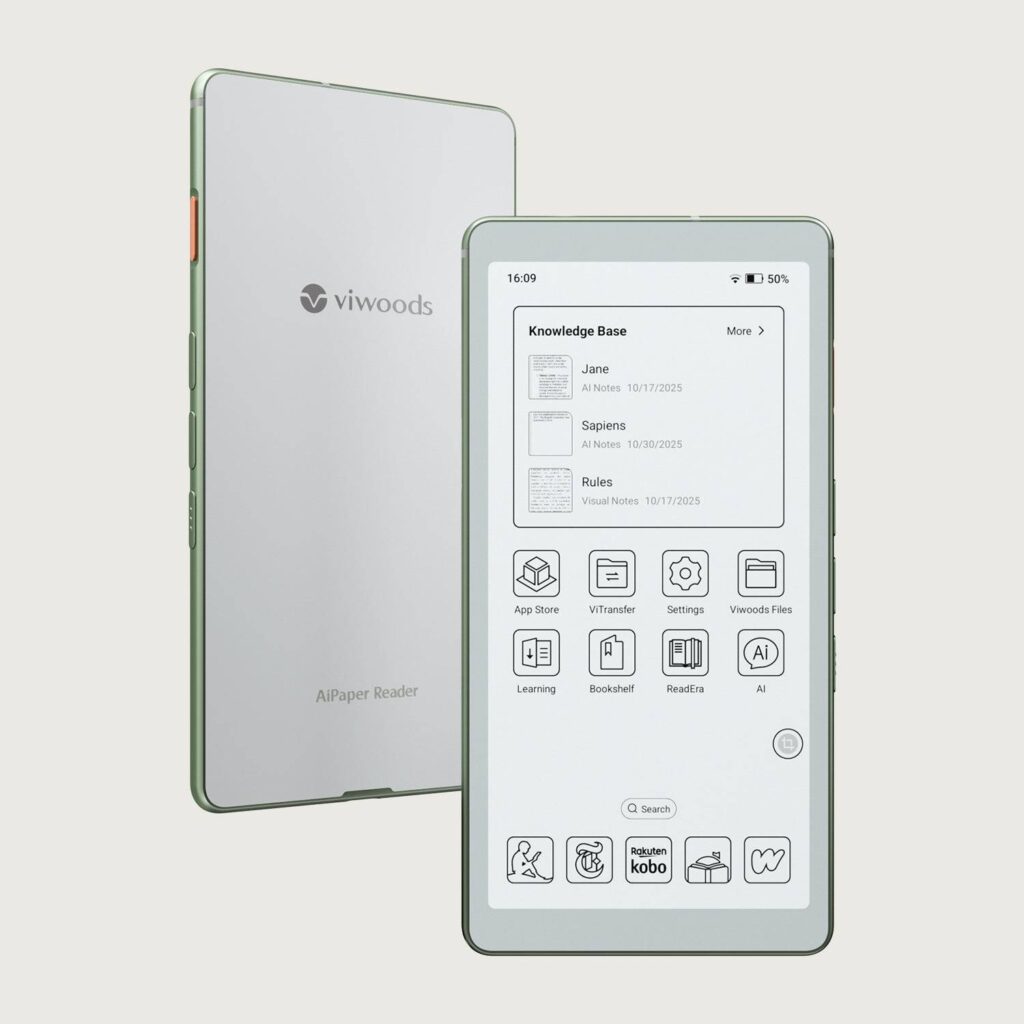
Viwoods AiPaper Reader: Specs, Features, Pros & Cons
The name is the first thing to get straight. Viwoods built its reputation on the AiPaper, a large writing tablet, and the AiPaper Reader borrows the branding without borrowing the pen. The company's own comparison chart lists this model as not stylus-compatible. It is a reading device, full stop, and anyone who assumed otherwise from the name is heading for a disappointment.
Underneath the name is a pocket e-reader with a SIM tray. The screen measures 6.13 inches, the aluminum body weighs 138 g, and the thing that separates it from every other small E Ink slab is mobile data: drop in a card and it stays online away from Wi-Fi, which matters if the whole point of carrying an e-reader was to leave the phone alone. Android 16 underneath means the reading apps you already use will install.
A dedicated hardware key on the side calls up an AI assistant that will summarize or explain whatever is on screen. Viwoods charges nothing extra for it and says the queries do not pass through its own servers, which is a better answer than most companies bother to give. Whether a reading device needs a button for that is a fair question, and the honest test is how often you reach for the same feature on your phone.
There is no speaker and no 3.5 mm jack, so audiobooks go to Bluetooth headphones or to a wired pair on the USB-C port, which the manual marks for headphones. The front light is cool-toned only, with no warm setting to take the edge off late at night, a real omission on a device this obviously built for reading in bed.
It is a niche product wearing a confusing name, but the niche is real: small, connected, and meant for people who read on the move.
Category strengths
Where the Viwoods AiPaper Reader beats the median
- Much more storage ?128 GB vs 64 GB (median)
- A lighter build ?138 g vs 167.5 g (median)
- Has cellular ?
Where the Viwoods AiPaper Reader trails the median
- No adjustable warm light ?
- No color display ?
- No stylus support ?
- No speakers ?
How this VS Score was computed
Score 48: each known spec is measured against the median of Android e-readers (8 products), then weighted. 46% of the scoreable weight could be used. See how we score
| Specification | This product | Cohort median | Score weight | Points moved |
|---|---|---|---|---|
| Adjustable warm light | No | 88% of the class have it | 1 | −48.0 |
| Internal storage | 128 | 64 | 0.7 | +35.0 |
| Page-turn buttons | Yes | 75% of the class have it | 0.5 | +25.0 |
| Color display | No | 50% of the class have it | 0.5 | −24.0 |
| Stylus support | No | 50% of the class have it | 0.5 | −24.0 |
| Weight | 138 — capped at the class’s lower range (140) | 167.5 | 2 | +20.0 |
| Cellular | Yes | 38% of the class have it | 0.2 | +10.0 |
| Speakers | No | 67% of the class have it | 0.2 | −9.6 |
| Screen size | 6.13 | 6.13 | 1 | +0.0 |
| Pixel density | 300 | 300 | 2 | +0.0 |
| RAM | 4 | 4 | 0.5 | +0.0 |
| Thickness | 6.7 | 6.7 | 0.5 | +0.0 |
Not scored: Resolution (one resolution dimension is not a sharpness measure; pixel density is scored instead); Front light (standard for the class (100% have it)); Auto-brightness (unknown: not scored); Flush screen (unknown: not scored); Dark mode (unknown: not scored); Touchscreen (standard for the class (100% have it)); EPUB support (standard for the class (100% have it)); Audiobook support (standard for the class (100% have it)); Text-to-speech (unknown: not scored); Library lending (unknown: not scored); Cloud sync (standard for the class (100% have it)); App store (standard for the class (100% have it)); Expandable storage (microSD) (unknown: not scored); Battery capacity (capacity is a proxy; the rated battery life is scored instead); Battery life (weeks) (too few comparable peers (2, need 3)); Charge time (unknown: not scored); USB-C (standard for the class (100% have it)); Wireless charging (unknown: not scored); Bluetooth (standard for the class (100% have it)); 3.5mm headphone jack (not applicable: only 0% of this class have it); Waterproof (unknown: not scored).
Editor’s note
The interesting question here is not whether this is a good e-reader (the Carta 1300 panel and its 300 ppi text layer make it a perfectly sharp one) but whether the cellular radio justifies the premium over the obvious alternatives. I think it does for a narrow group and not at all for everyone else. If you bought an e-reader specifically to stop carrying your phone everywhere, a device that syncs read-later articles, pulls library books and answers AI queries on its own SIM is close to the only one doing that job. Read at home on Wi-Fi and you are paying for a radio you will never switch on.
Storage is generous at 128 GB, and the only slot on the frame is for the SIM, which is the right way around for a device whose owners mostly sideload. The 2,580 mAh cell is small by e-reader standards, and Viwoods rates it at roughly a week at two hours a day, or about four weeks idle. Treat the first figure as the real one, because a cellular radio that is doing its job is never idle.
The omissions are where I would hesitate. There is no speaker, and the 6.7 mm aluminum body is the stated reason, so audiobooks always need headphones. Fair enough, but it makes the reading-device-that-replaces-your-phone pitch a leakier claim than the marketing implies.
Against a BOOX Palma-class device you trade mature software for connectivity and a newer Android base. Against a Kindle you trade polish and library integration for app freedom. Neither trade is obviously correct, and both come down to the same question: is the SIM tray a feature you will use, or a line item you paid for once and forgot about?
Specifications
Display
Reading
Storage & performance
Battery
Connectivity
Design
Sources and verification
Where the specifications come from
- Official product pageviwoods.com
Verification
- First published
- Specifications last checked
- Sheet completeness
- 28 of 39 specifications verified; the rest show as Unknown and are never estimated or scored
- Page type
- Product specification page — Compiled from the manufacturer’s published specifications and the cited sources; this is not a hands-on test.
- Basis
- Research-based: specifications and editorial text were compiled from the documents listed here and the manufacturer’s published data. We have not tested this unit ourselves; where independent measurements are mentioned they belong to the linked publication.
E-Readers with similar specs to the Viwoods AiPaper Reader
Ratings & reviews
No reviews yet. Be the first to share your experience.
The bottom line
The Viwoods AiPaper Reader earns a VS Score of 48, below the median of the 8 Android e-readers it is measured against (a score of 50 is level with that median).
- Who it’s for
- Readers who want a phone-sized device for books and saved articles, and who will use the SIM tray to keep it online without tethering.
- Who should look elsewhere
- Anyone expecting the writing tablet the AiPaper name implies, or who wants audiobooks played aloud, since there is no speaker.
- The trade-off that matters
- The cool-only front light keeps the panel neutral and bright by day, but there is no warm setting for late-night reading and no update can add one.
- The main alternative
- BOOX Go 6 is the obvious rival at this size if you want a conventional pocket e-reader and have no use for cellular data or an AI key.
This page was created with the help of AI. How we work