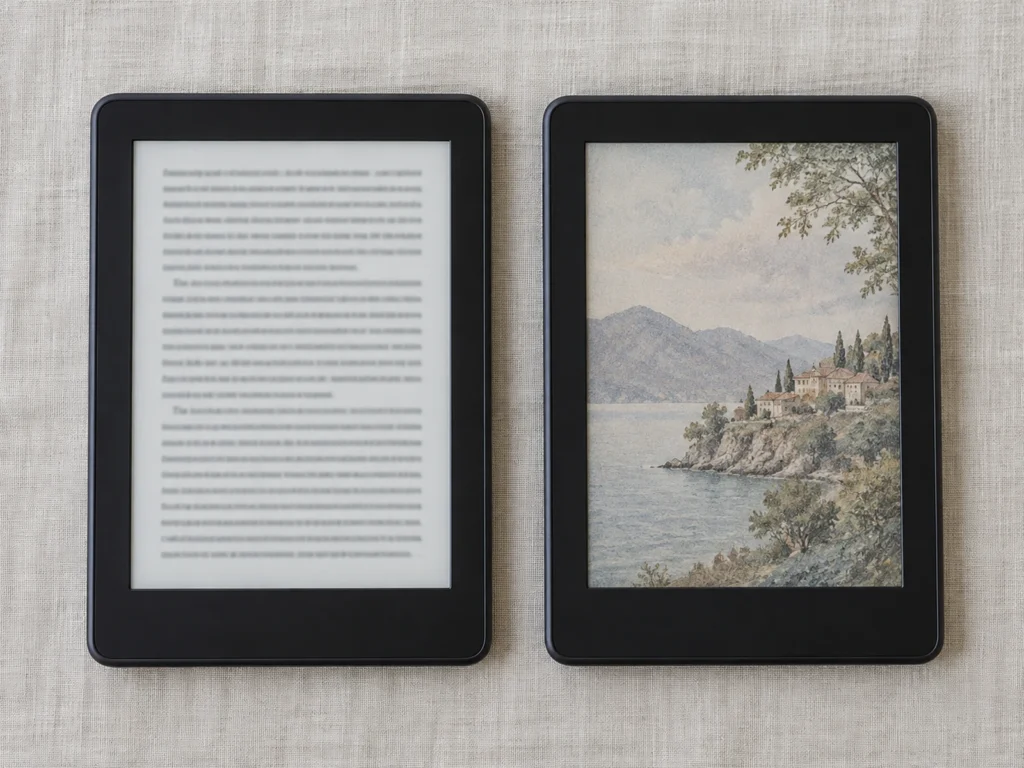
Twenty dollars separates the Kobo Clara BW from the Kobo Clara Colour, and that small gap hides a real trade-off. Both are six-inch waterproof e-readers with 16GB of storage. They share a 1448 x 1072 resolution, so black-and-white text is drawn on the same 300 PPI grid. Text can still look different, though, because the Colour adds a color filter layer over its screen. Kobo publishes no contrast or brightness figure that shows how much that layer changes a page of text. The other differences are in the processor and the battery, where Kobo’s footnotes make the comparison harder than it first looks. Prices are Kobo’s US store prices, checked on September 9 and again on October 26, 2026. They vary by region and change over time.
Who each reader is for
If you read prose, get the Clara BW. The Clara Colour is the pick when a meaningful part of your library has color in it, meaning comics, manga, illustrated non-fiction, cookbooks or study material you highlight in several colors.
Pixel density won’t decide it, because black-and-white text uses the same 300 PPI grid on both. The Colour’s filter layer sits over every page, colored or not, so it can change how plain text looks too. Choose on color support, the filter and battery behavior.
Two different screens at the same resolution
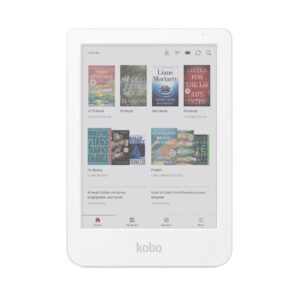
The Clara BW has a 6-inch glare-free E Ink Carta 1300 HD touchscreen at 1448 x 1072 with Dark Mode. The Clara Colour’s 6-inch E Ink Kaleido 3 display runs at the same 1448 x 1072 and also has Dark Mode. It adds a refresh feature that Kobo lists as FastGLR.
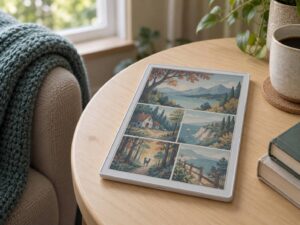
Kobo describes Kaleido 3 as the same papery E Ink surface with a color filter layer on top. Its explainer on the Kobo blog says the layer is a red, green and blue filter array, and that showing color means filtering some light out. The layer also costs density, and Kobo publishes how much. The Clara Colour shows black-and-white content at 300 PPI and color content at 150 PPI. Half the pixels per inch in each direction means a quarter as many color dots per square inch. A comic panel or a book cover is drawn on a much coarser grid than the text beside it.
How text looks also depends on how much light the page returns and how dark the ink looks against it. Kobo publishes no contrast or reflectance figure for either Clara. Its Clara BW page says the Carta 1300 screen has deeper contrast without saying compared with what. The Clara Colour page calls the palette soothing. One hint comes from E Ink, the panel maker, which announced Kaleido 4 on October 15, 2026. It says the new panel has 15 percent higher white reflectance and 50 percent more contrast than the previous generation. That’s Kaleido 3, the panel in the Clara Colour. E Ink has published no figure comparing Kaleido 3 with Carta 1300, so no published number sizes the gap between these two Kobos. If you’re weighing whether to wait for a Kaleido 4 e-reader, our explainer covers what those changes mean for plain text.
Both readers use ComfortLight PRO, which Kobo lists as adjustable brightness and color temperature. In the 2024 launch announcement, Kobo’s head of product said the company introduced collimated front lighting to its 6-inch and 7-inch eReaders to provide better colour performance. Kobo does not say whether the Clara BW shares that design or how much it changes a page.
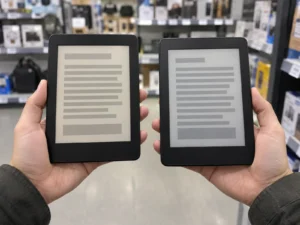
Kobo’s help center says some color images on its color screens can show a rainbow effect. Using the setting that reduces it may slow the reader or blur some images. Kobo also calls the palette subtle, and E Ink rates Kaleido 3 at 4,096 colors. Neither publishes a color gamut figure, so judge the color on a demo unit if you can. Our guide to Kobo at Best Buy explains what a side-by-side look in a store can and cannot settle.
Battery ratings taken at different light settings
Kobo rates the Clara BW at up to 53 days and the Clara Colour at up to 42 days. That’s weeks of use from either, and on paper the gap looks decisive.
Read the footnotes and the comparison changes. Kobo measures the Clara BW figure at 30 minutes of reading per day with the front light at 10 percent brightness and the radios off. It measures the Clara Colour figure at 30 minutes per day with the front light at 30 percent brightness and the radios off.
Since the light settings differ, 53 days and 42 days aren’t a like-for-like comparison. Kobo’s figures can’t tell you how big the gap would be at matched settings. A brighter light uses more power, so the BW’s 53 days would shrink at 30 percent. But a brightness percentage isn’t a calibrated amount of light across two different screens. Kobo says the Colour’s filter works by removing light, so you might turn the Colour up higher to get a similar page. The Colour also runs a faster dual-core processor. At your own settings, the gap could be smaller or larger than eleven days, and Kobo has published no matched test that would say which.
In hours, Kobo’s BW rating comes to about 26.5 hours of reading, or 53 days at half an hour each. The Colour’s is 21 hours, or 42 days at half an hour. Those totals include the standby time between sessions, so they aren’t hours of continuous reading. They also still come from different light settings.
Rakuten’s April 2024 launch announcement attached a single battery footnote, up to 53 days at 10 percent light, to both Clara models. Kobo’s current US store page gives the Clara Colour up to 42 days at 30 percent instead. Kobo hasn’t explained the change, and neither version is a matched test of the two readers.
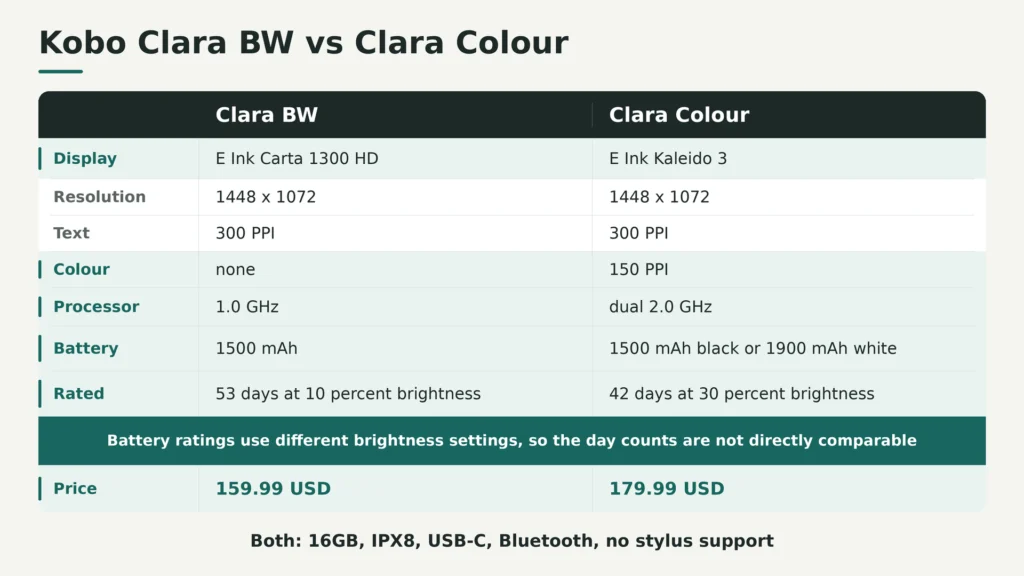
Battery capacity on the Clara Colour also depends on the finish. The black version has a 1500 mAh cell and the white version a 1900 mAh cell. The Clara BW uses 1500 mAh. So a black and a white Clara Colour hold different amounts of charge. Kobo still gives both finishes the same 42-day rating and doesn’t say which one it tested.
Processor, storage and connectivity
The Clara Colour has a dual 2.0 GHz processor and the Clara BW a 1.0 GHz one. Kobo doesn’t say why the Colour gets the faster chip. It also publishes no page-turn or app-speed figures for either model, so clock speed alone won’t tell you which one feels quicker.
Each has 16GB of storage, which Kobo rates at roughly 12,000 eBooks. Both use dual-band Wi-Fi (802.11 ac/b/g/n across 2.4 GHz and 5 GHz), include Bluetooth for audiobooks and charge over USB-C. An IPX8 rating covers the pair, good for up to 60 minutes in up to 2 meters of water.
Neither model works with the Kobo Stylus, so skip both if you want to write on the screen.
Reading features you get on both
Both readers include library borrowing through Libby, Kobo Store purchases, audiobook playback over Bluetooth and Instapaper for saved articles. They also share adjustable fonts and margins, ComfortLight PRO for blue light reduction and StoryGraph reading tracking, so the software doesn’t separate them.
The color panel gives the Clara Colour one extra feature: highlights in several colors that you can change afterward. That matters if you annotate study texts or book club reading, because every highlight looks the same on a monochrome screen.
Which one should you buy?
If your reading is mostly novels and text-heavy non-fiction, choose the Clara BW at $159.99. You get the same 300 PPI text grid with no color filter over it, and you save money. Its battery rating, taken at 10 percent brightness, is also closer to your own use if you keep the front light low. Our full specification breakdown of the Kobo Clara BW covers the panel and build in more detail.
The Clara Colour at $179.99 makes sense if color does real work in your library. Comics, manga, illustrated reference books and multi-color highlighting all justify the extra $20. You do have to accept that color is drawn at 150 PPI and that Kobo describes the palette as subtle. The specification record for the Kobo Clara Colour sets out exactly what the Kaleido layer changes.
For a first e-reader bought purely to read books, the BW is still the more sensible buy. If you’re unsure how the filter layer looks on text, compare the two side by side before you decide. The price gap is small enough, though, that anyone who already knows they read illustrated material shouldn’t agonize over it.