BOOX Note Max: Specs, Features, Pros & Cons
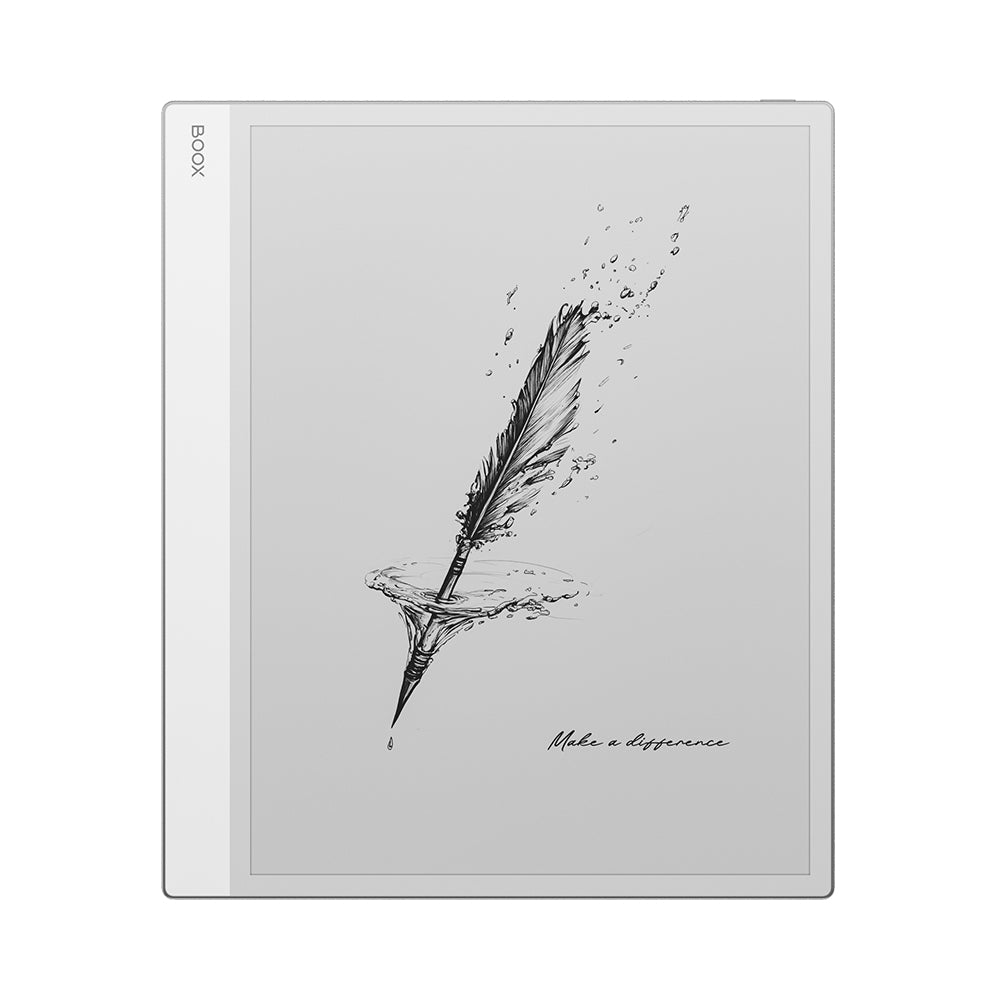
The first thing to understand about the Note Max is what BOOX left off it. There is no front light. On a device this expensive that reads like an omission, but it is a deliberate trade: without a light-guide layer stacked above the E Ink panel, the page sits closer to the glass and looks more like printed paper in daylight. The cost is just as simple. When the room goes dark, so does the Note Max.
What BOOX gets in return is size. This is an A4-class writing slate, big enough to show a full letter-size PDF page at something close to print scale, which is the one thing smaller E Ink tablets never manage. Academic papers, sheet music, contracts and technical drawings stop needing constant zooming. It is also unusually slim for the panel it carries, and the pen comes in the standard bundle.
Underneath, it is a full Android tablet with the Play Store, so the software question is the same as on every BOOX: you can install almost anything, and you have to accept that most apps were designed for a glossy screen that redraws instantly. BOOX's own notes and reader apps are where the device is at its best. Third-party apps are a bonus to explore rather than a reason to buy.
The buyer this makes sense for works at a desk or in daylight, reads large-format documents for a living, and wants to annotate them without printing. Anyone who reads in bed, on evening flights or mostly for pleasure will find the missing light and the sheer size a constant irritation, and a smaller lit device will serve them better for considerably less money.
Category strengths
Where the BOOX Note Max beats the average
- Much more storage ?128 GB vs 64 GB (avg)
- Much more RAM ?6 GB vs 4 GB (avg)
- A bigger screen ?13.3" (33.78 cm) vs 10.3" (26.16 cm) (avg)
- Higher resolution ?3,200 px vs 2,480 px (avg)
- A slimmer body ?4.6 mm vs 5.8 mm (avg)
- A slightly higher android version ?13 vs 12 (avg)
Where the BOOX Note Max trails the average
- No front light ?
- No adjustable warm light ?
- A heavier build ?615 g vs 435 g (avg)
- No color display ?
How this VS Score was computed
Score 46: each known spec is measured against the median of E Ink note e ink tablets (10 products, medians winsorised to the 10th–90th percentile), then weighted. 51% of the scoreable weight could be used; unknown values, features not applicable to this class and proxies (battery capacity where a rated life exists) add or remove nothing.
| Specification | This product | Cohort median | Score weight | Points moved |
|---|---|---|---|---|
| Front light | No | 70% of the class have it | 1 | −48.0 |
| Internal storage | 128 | 64 | 0.7 | +35.0 |
| Color display | No | 50% of the class have it | 0.7 | −33.6 |
| Adjustable warm light | No | 70% of the class have it | 0.7 | −33.6 |
| RAM | 6 | 4 | 1 | +25.0 |
| Screen size | 13.3 | 10.3 | 1.5 | +22.5 |
| Weight | 615 | 435 | 1.5 | −22.5 |
| Thickness | 4.6 | 5.8 | 0.7 | +9.1 |
| Android version | 13 | 12 | 0.5 | +2.0 |
| Pixel density | 300 | 300 | 1.5 | +0.0 |
| Pen pressure levels | 4,096 | 4,096 | 0.7 | +0.0 |
| Battery capacity | 3,700 | 3,700 | 1.5 | +0.0 |
Not scored: Resolution (one resolution dimension is not a sharpness measure; pixel density is scored instead); Fast refresh modes (standard for the class (100% have it)); Stylus included (standard for the class (90% have it)); Pen latency (unknown: not scored); Palm rejection (unknown: not scored); Handwriting recognition (unknown: not scored); Pen eraser (unknown: not scored); App store (standard for the class (100% have it)); Cloud sync (standard for the class (100% have it)); Subscription required (unknown: not scored); Screen mirroring (unknown: not scored); Split-screen (standard for the class (100% have it)); Expandable storage (microSD) (unknown: not scored); Battery life (weeks) (unknown: not scored); Charge time (unknown: not scored); USB-C (standard for the class (100% have it)); Bluetooth (standard for the class (100% have it)); 5 GHz Wi-Fi support (unknown: not scored); Keyboard support (standard for the class (100% have it)); Speakers (standard for the class (100% have it)); Microphone (standard for the class (100% have it)); Rear camera (unknown: not scored); Biometric unlock (unknown: not scored).
Editor’s note
The Note Max is the rare E Ink device where screen size is the whole argument, so the first question is whether you handle documents that suffer on a smaller panel. If most of what you read reflows – EPUBs, articles, anything with adjustable text – a bigger screen mostly buys you wider margins. If you work with fixed layouts, the 13.3-inch Carta 1300 at 300 ppi is the difference between reading a PDF and squinting at one, and that is what the price pays for.
The missing front light is the decision that will split buyers. I think BOOX was right to offer a light-free model, because the unlit panel has nothing between you and the ink, but I would not buy one as my only reading device. A desk lamp becomes part of the kit. For office work that costs nothing. For a commuter or a night reader it is disqualifying.
Weight is the other honest limitation. At roughly 615 g it is light for a slate this size and heavy for anything you hold in one hand, so it lives flat on a desk or propped in a case. The 6 GB of RAM and the octa-core chip keep BOOX's own apps responsive, and the Android release is recent enough for current Play Store apps, but E Ink refresh still limits what those apps can do.
Value depends on the alternatives you would consider. The reMarkable Paper Pro gives you a lit colour screen and closed, focused software at a smaller size. The Kindle Scribe is simpler but tied to Amazon's software. Against both, the Note Max wins on canvas and openness and loses on convenience. For lawyers, researchers and musicians who spend their day inside PDFs, I think that is a fair exchange.
Specifications
Quality bars are generated automatically against 9 other e ink tablets.
Display
Writing
Software
Performance
Battery
Connectivity
Design
Sources and verification
Where the specifications come from
- Official product pageshop.boox.com
Verification
- First published
- Specifications last checked
- Sheet completeness
- 27 of 41 specifications verified; the rest show as Unknown and are never estimated or scored
- Page type
- Product specification page — Compiled from the manufacturer’s published specifications and the cited sources; this is not a hands-on test.
- Basis
- Research-based: specifications and editorial text were compiled from the documents listed here and the manufacturer’s published data. We have not tested this unit ourselves; where independent measurements are mentioned they belong to the linked publication.
E Ink Tablets with similar specs to the BOOX Note Max

Ratings & reviews
No reviews yet. Be the first to share your experience.
The bottom line
The BOOX Note Max earns a VS Score of 46, a solid mid-pack result among the 10 e ink tablets we compare here.
- Who it’s for
- Researchers, lawyers and musicians who live in fixed-layout PDFs and want to mark them up at close to printed size, mostly at a desk or in good daylight.
- Who should look elsewhere
- Anyone who reads in bed or on evening travel – there is no built-in light at all – or who mainly reads reflowable books, where the extra size adds bulk without adding much.
- The trade-off that matters
- Leaving out the front light gives a cleaner page in daylight, but it makes a lamp part of the setup whenever the light drops.
- The main alternative
- BOOX Note Air5 C, if you want a front light and a size you can hold in one hand, and can live with a smaller canvas for your PDFs.
The VS Score is calculated from the weighted specifications above, compared with every other e ink tablet we track — a shortlisting guide, not a substitute for your own priorities. See how we score.