E Ink copper ink moved from a laboratory idea to a funded one on 10 September 2026, when E Ink Corporation invested in a United States startup called NewCopper. The announcement reads like a supply-chain story, and that is what it is. No e-reader on sale today changes because of it, and none will change this year. Still, the reasoning behind the deal explains something useful about why e-paper costs what it costs, why flexible screens stay rare, and which part of a display has quietly become the expensive bit.
What E Ink announced, and on what date
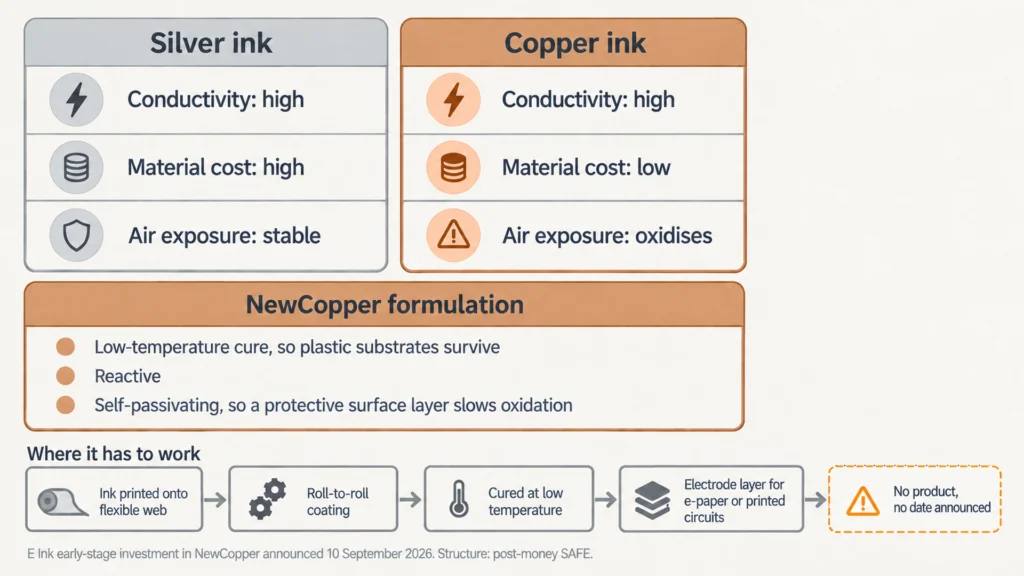
The announcement carried a dateline of 10 September 2026. E Ink Corporation said it had made an early-stage investment in NewCopper, a privately held United States technology startup developing conductive copper ink.
The structure is worth noting because it sets the timeline. E Ink is investing through a post-money Simple Agreement for Future Equity, usually shortened to SAFE. Johnson Lee, E Ink’s chairman and chief executive, joined NewCopper’s board of directors as the company’s designated representative.
E Ink also said it would apply its display manufacturing expertise to help NewCopper scale up production. The stated benefit to E Ink is an opportunity for its research team to evaluate copper ink as a potential conductive material for future displays and electrode applications, and to strengthen a more localised supply chain for advanced electronic materials.
Johnson Lee framed it around the gap between a laboratory and a factory. “E Ink itself spun out of academia into a global technology company, so we recognize both the promise of NewCopper’s innovation and the challenges of moving breakthrough technology from the lab to the market,” he said.
The copper ink NewCopper makes
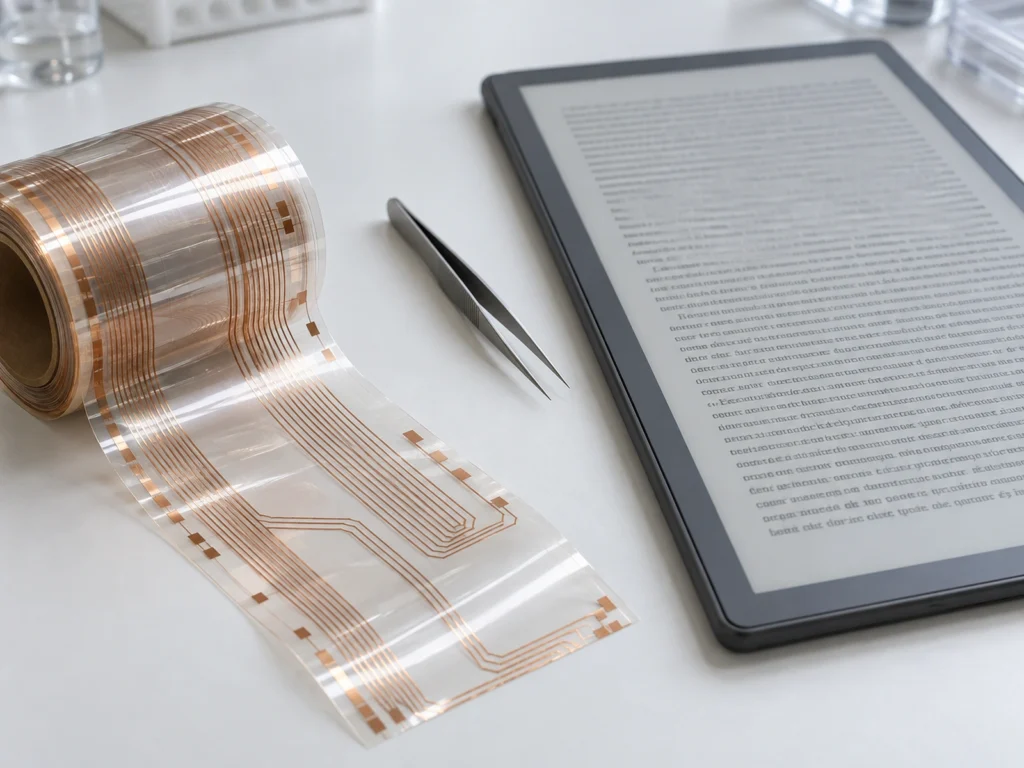
NewCopper’s product is a copper-based conductive ink meant to replace silver ink. The formulation is described as low-temperature, reactive and self-passivating, and it came out of joint research by Professor Shenqiang Ren’s team at the University of Maryland and Professor Liangbing Hu at Yale University. NewCopper holds an exclusive licence from the University of Maryland for the formulation.
Those three adjectives each solve a specific problem, so they are worth unpacking.
Low temperature matters because printed electronics often sit on plastic. A conductive ink normally needs heat to sinter, meaning the metal particles fuse into a continuous path, and too much of that heat distorts or melts the plastic film underneath. An ink that cures cool can be printed onto substrates a hot process would ruin.
Self-passivating addresses the reason copper has stayed a laboratory promise. Passivation means the surface forms a thin protective layer that slows further reaction, which is the same principle that keeps aluminium from corroding away.
Why copper has stayed out of printed electronics
Copper conducts almost as well as silver and costs a fraction as much. On paper it should have replaced silver ink years ago. Oxidation is the reason it did not.
Once oxidised, copper conducts poorly. A printed copper trace that tarnishes also loses the property it was printed for. That degradation continues in storage, during curing and across a product’s life, which makes reliability testing brutal. Silver stays expensive partly because it tolerates air.
The market pressure is real, and E Ink named it directly. As flexible electronics spread into displays, sensors, solar, radio-frequency identification and connected devices, manufacturers are looking for something cheaper than silver ink. E Ink also pointed at printed circuit board materials for artificial intelligence and data-centre use, which tells you the target market is far wider than e-readers.
Where a conductive ink sits in an e-paper screen
An electrophoretic display works by moving charged pigment particles with an electric field. Producing that field takes electrodes on both sides of the film, a transparent common electrode on the side you look at and a patterned electrode layer behind it.
In a high-resolution reading device, that patterned layer is a thin-film transistor backplane, made with semiconductor processes. In simpler e-paper, such as a shop shelf label or a signage panel with a handful of fixed segments, printed conductive traces do much more of the work.
E Ink was careful about this in its own wording. The release says copper ink gives its team an opportunity to evaluate the material for future displays and electrode applications. It does not say the material is going into any specific panel, and it names no product.
Roll-to-roll is the phrase that matters
One line in the announcement does more work than the rest. NewCopper’s formulation is compatible with E Ink’s roll-to-roll coating capability.
Roll-to-roll means the material is coated onto a continuous flexible web that unwinds from one roll and rewinds onto another, instead of being processed sheet by sheet. It is the cheap way to cover large areas, and it is the process behind flexible and large-format e-paper. A new conductive material that cannot survive roll-to-roll is a laboratory curiosity to a company like E Ink. One that can is worth a board seat.
Large panels are where material cost bites
Here is the part that connects to buying decisions. Material cost scales with coated area, so the saving from a cheaper conductive ink shows up first on big panels, not on a six-inch reader.
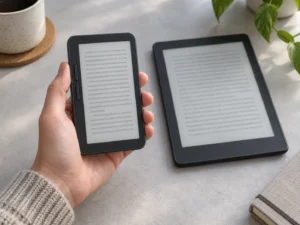
Think about the difference in practical terms. A 13.3-inch writing slate such as the BOOX Note Max carries roughly four times the screen area of a compact 6-inch e-reader, and its price reflects that gap far more than its feature list does. Large E Ink devices have always cost disproportionately more than their diagonal suggests, and materials are one honest reason among several.
So if copper ink eventually reaches production panels, the first visible effect would land on the expensive end of the range. That is our expectation. E Ink made no forecast and said nothing about pricing.
How a SAFE sets the timing
A Simple Agreement for Future Equity is an early-stage funding instrument. It converts to equity later, on terms set by a future priced round. Companies use it precisely when a business is too young for a conventional valuation.
That is the clearest signal in the whole announcement. E Ink is not buying a qualified material from a running production line. It is funding a startup to scale one, while reserving the right to test whether it works in a display. No date has been announced by which copper ink reaches a shipping product.
What this will not change about your next e-reader
Three things are worth saying, because coverage of materials deals tends to drift.
Copper ink is not a colour technology, so it will not make Kaleido or Gallery panels more saturated. It is not a refresh-rate technology either, so page turns and pen latency stay where they are. And it is not a 2026 product change, so a reader choosing a device this autumn should ignore it entirely.
What it may eventually influence is cost and form factor, on a horizon measured in years.
The honest summary
E Ink made a small early bet on a cheaper conductor, on 10 September 2026, with a board seat attached and no product commitment. The technical problem NewCopper claims to solve is genuine, and copper’s oxidation behaviour has blocked cheaper printed electronics for a long time.
Treat it as a signal about where display costs sit, then go back to judging e-readers on the screens, software and support they ship with today.