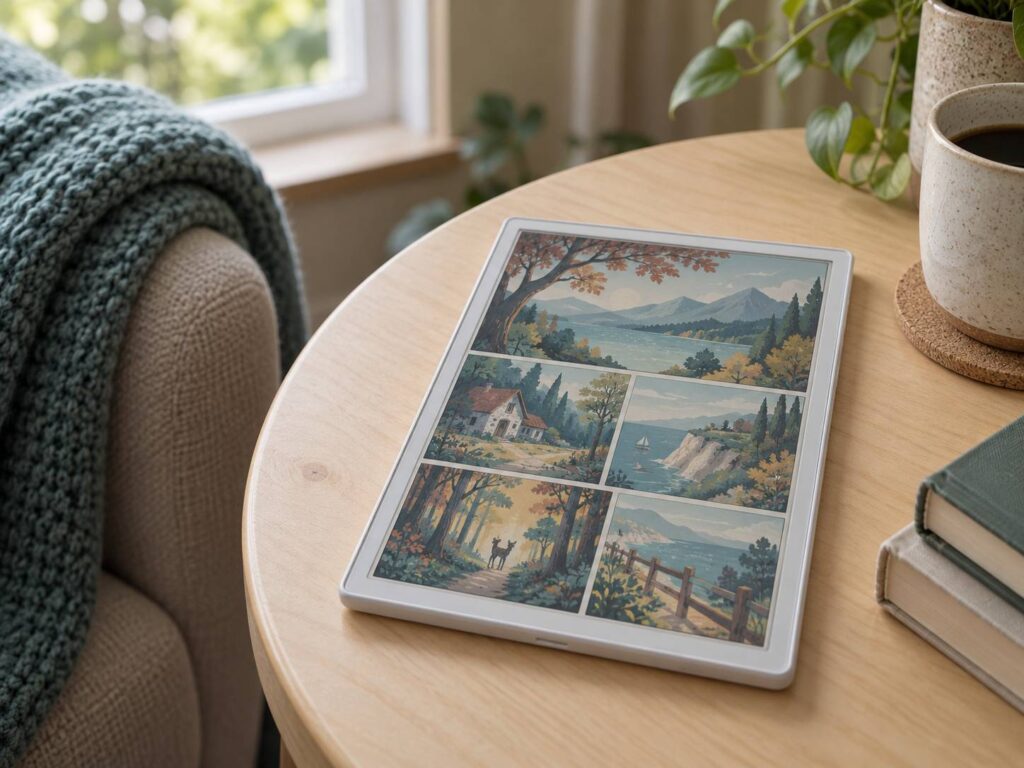
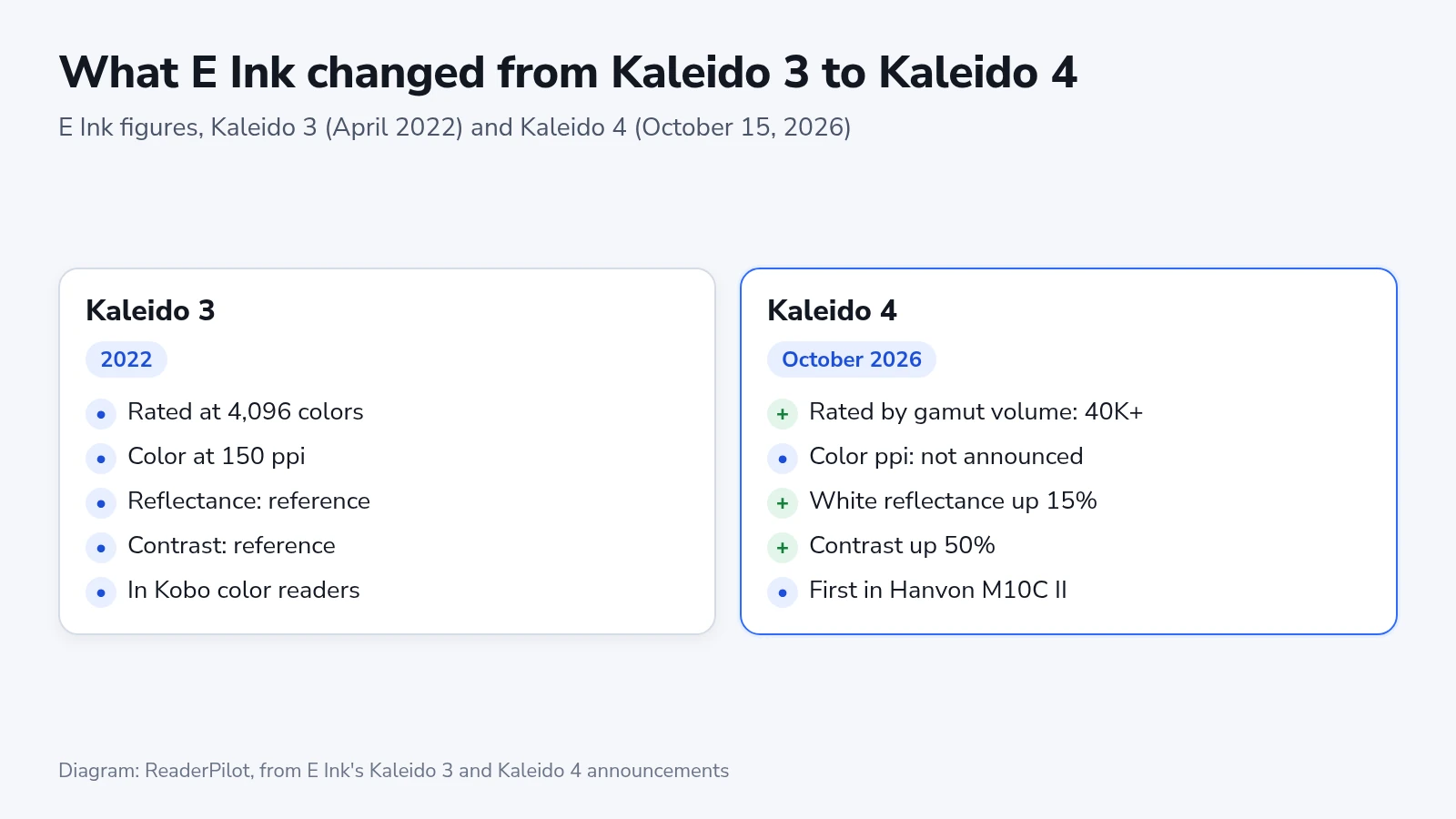
None of the color e-readers on US shelves this fall has E Ink’s new Kaleido 4 screen. Waiting for one makes sense mainly for color comics and PDFs. E Ink launched the panel on October 15, 2026. It calls the M10C II, a note-taking tablet from the Chinese maker Hanvon, the world’s first product with Kaleido 4, and so far it’s the only one. E Ink gives four numbers measured against Kaleido 3. The color gamut volume doubles, white reflectance rises 15 percent and contrast 50 percent, and video runs at up to 18 frames per second. Kobo moved to Kaleido 3 two years after E Ink launched it.
What E Ink measured against Kaleido 3
Kaleido screens put a layer of tiny color filters over the same black-and-white ink film that monochrome readers use. Kaleido 3, the version inside Kobo’s color readers, is the baseline for every new figure. E Ink credits the gains to a new oxide TFT backplane that drives the ink at higher voltages and refreshes it faster. It also credits an updated color filter and a redesigned front light.
White reflectance is the share of room light the page bounces back. The color filter covers the whole screen, so it dims plain text pages as well as pictures. A brighter white helps both, and the higher contrast works on the same problem. E Ink also says the changes make color images look less grainy.
The release says page turns and scrolling on the M10C II are 27 percent faster. It credits that to the new backplane together with a Hanvon timing controller and a Hanvon technology called Enhanced Pressure Floating.
Color resolution is the missing number
Kaleido 3 shows black-and-white text at 300 pixels per inch and color at 150 PPI. The gap comes from the filter: one color dot covers a square of four black-and-white pixels, two across and two down. That’s why a comic panel looks softer than the lettering inside its speech bubbles.
E Ink’s October 15 announcement gives no color resolution for Kaleido 4, and that’s the figure a comics reader needs. A color layer at the full 300 PPI would put one color dot over each black-and-white pixel. By our arithmetic, the same patch of screen would then carry four times as many color dots as Kaleido 3.
Until E Ink or a device maker prints a color resolution on a spec sheet, any figure for it is a guess.
A gamut volume is not a count of colors
E Ink rates Kaleido 3 at 4,096 colors. For Kaleido 4 it switches to a different measure, color gamut volume, which it says doubled to more than 40K. A gamut volume describes how far a screen reaches toward strong, saturated colors. It doesn’t count separate shades, and the release gives no unit for it. So the new figure can’t be compared with 4,096, and it doesn’t mean 40,000 colors.
Resolution limits how fine a line on a map or the dot pattern in manga shading can be. Gamut affects how deep a red or a blue looks.
Two years from Kaleido 3 to a Kobo
E Ink launched Kaleido 3 on April 7, 2022. Kobo’s first color readers, the Clara Colour and the Libra Colour, arrived in April 2024. A new screen generation doesn’t have to follow the same calendar.
Buying a color reader this fall
Kaleido 3 already shows black-and-white text at 300 PPI, the same as Kobo’s monochrome Clara BW. Nothing in E Ink’s announcement points to sharper text. On a page of plain text, the gains would be the lighter background and the higher contrast. Someone who rarely opens a picture can skip the filter entirely with a monochrome Kobo or Kindle.
Comics, color PDFs and textbook diagrams are drawn on the coarser color grid of the Kobo Clara Colour. They would gain the most from a finer grid, if Kaleido 4 turns out to have one. The deeper gamut, which E Ink has confirmed, helps them too.
If those pages are the reason you want a color screen, watch for the first Kobo or BOOX spec sheet that lists Kaleido 4 along with its color resolution.