

BOOX put the Note Air6 C on sale on September 15, 2026, eleven months after the model it replaces. The listing price in the United States is $579.99 for the standard bundle, against $529.99 for the Note Air5 C. So the upgrade costs $50, and the specification sheet shows exactly two changes behind that number. Everything else, from the panel to the battery to the weight, carries over unchanged. This guide sets out what those two changes buy, why a third device released the same day muddies the decision, and who should stay on what they already own.
Two changes behind the price gap
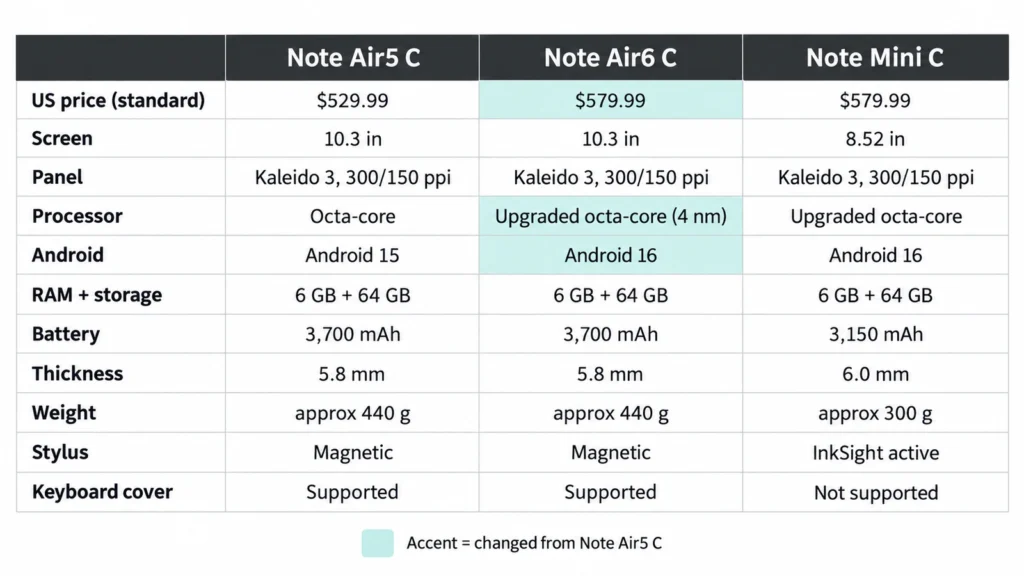
The side-by-side comparison BOOX publishes for its colour notebooks is unusually blunt. Against the Note Air5 C, the Note Air6 C lists an upgraded octa-core processor and Android 16 in place of Android 15. That is the entire difference.
The company footnotes the chip detail: the Note Air6 C uses an upgraded octa-core processor built on a 4 nanometre process node. A smaller process usually means better performance per watt, and BOOX publishes no clock speed or benchmark for either generation. So treat this as a generational refresh of the silicon whose gain nobody has measured.
What stayed the same, and why that matters
The carried-over list is long. Both models use a 10.3 inch Kaleido 3 colour panel at 300 ppi for monochrome and 150 ppi for colour. Each ships 6 GB of RAM and 64 GB of storage with a microSD slot. They hold a 3,700 mAh battery, measure 5.8 mm thick, weigh about 440 grams, and support the same magnetic stylus and magnetic keyboard cover. A fingerprint lock, an adjustable front light and auto-rotation appear on both.
If you already own the BOOX Note Air5 C, that list is the answer to your question, because the reading and writing experience is built on hardware that did not move. A faster chip helps app switching and page rendering, and Android 16 extends the software runway. Neither changes how the panel draws text or how the pen feels.
The Note Mini C complicates the choice
BOOX published a second colour notebook on the same day, and its pricing is the detail most coverage has wrong. In the BOOX store the Note Mini C lists at $579.99 in the United States, which is the same price as the Note Air6 C, not lower. The Hong Kong listing for both sits at $549.99.
The Mini C is a different machine. It uses a smaller 8.52 inch Kaleido 3 panel, runs the same upgraded octa-core processor and Android 16, and carries the same 6 GB of RAM and 64 GB of storage. It is 6.0 mm thick and weighs about 300 grams, so it is 140 grams lighter. Its battery is smaller at 3,150 mAh. It supports an InkSight active stylus instead of the magnetic stylus, and BOOX lists no keyboard cover support for it at all.
That last point decides a lot. If you intend to type on the device, the Mini C is out, and the Note Air6 C keyboard cover bundle runs $656.99 in the United States, or $77 above the standard bundle.
Talk Insights does not work everywhere
One new software feature deserves a regional warning that product pages bury in a footnote. Talk Insights provides real-time transcription and is enabled through Settings and Lab Features after a firmware update. BOOX states that it requires an internet connection and is available only in selected regions, listing the United States, Canada, Taiwan, Japan, South Korea and Australia, and in selected languages including English, Chinese, Spanish, Japanese, Korean, French and Arabic.
European buyers should read that carefully. A feature promoted in launch coverage may not appear on a device bought in a market outside that list. BOOX also notes that recording quality varies with environment, speaker volume and distance, which is the sensible caveat for any on-device transcription.
Update support is the quiet argument
BOOX commits to free firmware updates for all models for more than three years from the product launch date. Apply that and the picture clarifies.
The Note Air5 C reached the store in October 2025, so its guaranteed window already has almost a year spent. The Note Air6 C starts its clock in September 2026. For a device that costs several hundred dollars and depends on an app store, an extra eleven months of committed updates is a real part of what the $50 buys, arguably a larger part than the processor.
The move from Android 15 to Android 16 works the same way. It is not about features you will notice on day one. It is about how long third-party reading and note apps keep supporting the platform underneath.
So who should buy which
- Buying a colour E Ink notebook for the first time and want the keyboard option: take the Note Air6 C.
- Want the lightest colour notebook and will never type on it: the Note Mini C saves 140 grams for the same money.
- Already own a Note Air5 C: keep it. The panel, pen, memory and battery are identical, and the gains are a faster chip plus a longer update window.
- Own a Note Air3 C or older: the jump is far larger, and the Note Air6 C is the sensible target.
The honest summary
This is a maintenance release wearing a new model number, and BOOX does not pretend otherwise in its own comparison table. That is not a criticism. The Note Air5 C hardware was strong, and refreshing the chip and the Android version while holding the price close is a reasonable way to keep a product current.
Buy it for the right reason. The Note Air6 C is a good first colour notebook and a poor upgrade from last year’s model. Anyone hoping the new number signals a better screen, a faster pen or longer battery life should read the comparison table before ordering, because none of those numbers moved.