More than 30 million people who bought e-books on Amazon could soon be part of one lawsuit against the company. Magistrate Judge Gabriel W. Gorenstein has recommended that a federal court in New York certify the class in the Amazon e-book class action, an antitrust case consumers filed in January 2021. His report was first filed under seal on August 10, 2026. You are in the proposed class if you bought at least one e-book from one of the five largest US publishers on Amazon.com since January 14, 2017, and paid between $4.00 and $49.99 for it. No court has found that Amazon broke the law, and there is no claim form to fill in.
Amazon’s commission, as the buyers tell it
The case is about commission, and Amazon does not set the prices of these books itself. Hachette, HarperCollins, Macmillan, Penguin Random House and Simon & Schuster sell e-books on the agency model, where the publisher sets the price and the store keeps a share. The buyers argue that Amazon’s contracts with those publishers kept other stores from selling the same books for less, so Amazon could take a bigger share without losing readers to a cheaper store. The complaint puts that commission at least 30 percent above what a competitive market would allow.
The 35-page report has not been posted publicly, and its wording is known from the announcement the buyers’ lawyers at Hagens Berman issued on October 2. It describes a switch from what Amazon called Hybrid Seller of Record contracts to Tiered Seller of Record contracts, after which “Amazon virtually stopped price-matching” and its effective commission “increased sharply and then stabilized at a materially higher level.” Those are the plaintiffs’ allegations as the judge summarized them, not findings.
In March 2024, District Judge Gregory H. Woods dismissed the publishers from the case and let two claims against Amazon go ahead, monopolization and attempted monopolization. Judge Woods will now decide whether to adopt the class recommendation.
The purchases that count
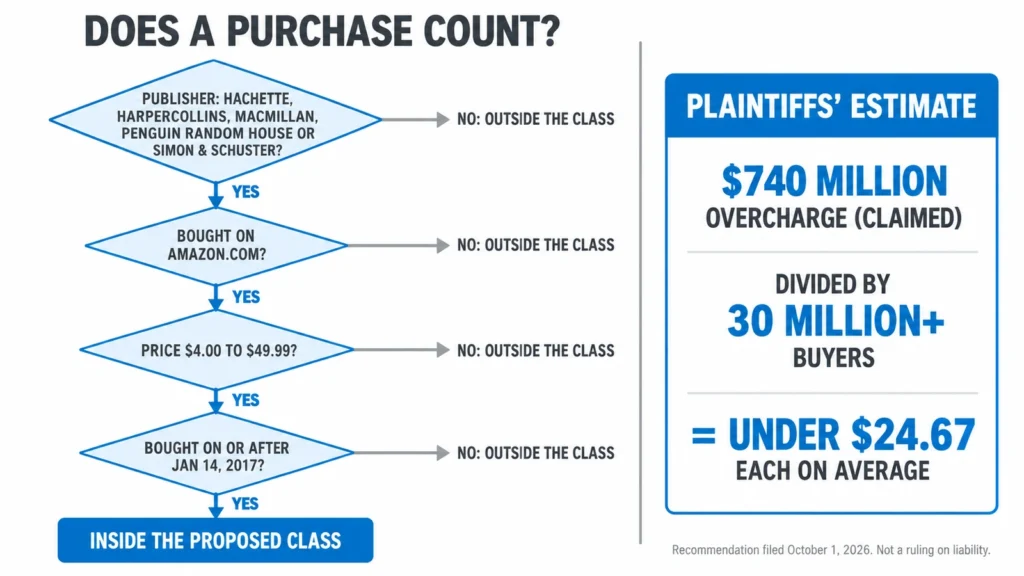
The class definition has four conditions, and each one rules out books many Kindle owners will have bought.
The publisher has to be one of the five. Kindle store pages usually show the imprint, which hides the parent company: Knopf and Doubleday belong to Penguin Random House, Tor and St. Martin’s to Macmillan. Self-published books and Amazon’s own publishing imprints are outside the definition.
A book bought on Amazon’s UK or Canadian store falls outside the wording, which names Amazon.com.
The price has to fall between $4.00 and $49.99. That leaves out the $1.99 and $2.99 daily deals, and anything read through Kindle Unlimited or Prime Reading, which are loans rather than purchases.
The start date has a reason behind it. January 14, 2017, is exactly four years before the suit was filed, and four years is the limit federal antitrust law sets for claiming damages. The class runs from then to the day it is certified, so a Big Five e-book you buy this month still counts. Your Orders page on Amazon.com lists Kindle purchases with their prices under Digital Orders, which is the quickest way to check.
What $740 million would mean for one reader
The plaintiffs’ damages expert, Dr. Jamie McClave, built her model on 658 million Amazon e-book transactions spanning nearly a decade. She concluded that buyers paid “over $740 million more” for Big Five e-books than they would have in a competitive market. That is the plaintiffs’ estimate, which Amazon can contest, and the judge’s report accepts only that the model fits the plaintiffs’ theory well enough for the case to proceed as a class.
Spread across the class, the figure is small. $740 million divided by 30 million buyers is about $24.67 each, and because the class is “more than” 30 million, the true average is lower. Over the nine years and eight months from January 2017 to this October, that is about $2.50 a year. The model’s 658 million transactions cannot be turned into a per-book figure, because the announcement does not say how many of them are class purchases. A heavy reader of Big Five novels would sit well above the average, and someone who bought two books in 2018 well below it.
If a jury found Amazon liable and accepted the figure, federal antitrust law would triple it. A settlement, if one comes, would be negotiated from there.
An earlier e-book case shows how a payout reached readers. Apple’s $400 million settlement over e-book price fixing paid out in June 2016, as $6.93 for each New York Times bestseller and $1.57 for every other book bought from five publishers between April 2010 and May 2012. Buyers at Amazon, Apple, Barnes & Noble and Kobo got the money as account credit automatically, unless they had asked for a check.
The switching argument, from the reader’s side
A second plaintiffs’ expert, the economist Wickelgren named in the report, puts Amazon’s share of the market “consistently within the range of 69-74%” during the class period. He also points to Amazon’s “use of proprietary software and eBook reading devices to limit consumer switching.”
Whatever the court makes of that, the practical side is familiar to anyone with a library on one device. A Kindle opens books from Amazon’s store and files you send to it, but it cannot open a book bought from Kobo or Apple with that store’s copy protection. A Kobo Clara BW reads Kobo store books and protected EPUBs from other shops, and it cannot open your Kindle purchases. Owners who want both stores on one screen need an Android E Ink device that runs both apps.
Next steps while Judge Woods decides
Amazon has already objected. Judge Woods extended its deadline to September 8, 2026, the day Amazon filed its objection, and gave the buyers until October 6 to respond. If Judge Woods certifies the class, buyers will be sent notice and given a chance to opt out. In the Apple case, buyers were told about their credit by email, so keep the email address on your Amazon account current.
Treat any message that asks for your Amazon password or a fee to “join” the case as a scam. Certification does not cost class members anything, and nothing has been offered yet.