

Kobo has quietly made its cheapest perk cheaper. Until recently, a successful price match paid out the difference plus an extra 10 percent. That bonus has gone. The Kobo Price Match Guarantee now credits the gap between what you paid and what an authorised competitor charges, and nothing more. The change surfaced in emails to customers on 18 September 2026, and Kobo’s own help page, read on 19 September 2026, no longer mentions any additional percentage.
The change, in Kobo’s words
Customer emails from Kobo said it had updated the policy, that the update removes the additional 10 percent discount previously offered on top of the competitor’s price, and that the guarantee will now only match the verified competitor’s price. Kobo issued no press release.
The help page supports it. Kobo’s current description says that if you buy an eBook and then find the same book or audiobook cheaper on a competitor’s website, you can ask Kobo to credit the difference, excluding taxes. No extra percentage appears anywhere in the text.
One caveat belongs here. The page carries no effective date and no revision note, so the exact day the wording changed on Kobo’s site is not known. What I can confirm is the current text and the absence of the bonus from it.
What the guarantee gives you now
The mechanism is the same as before, minus the sweetener. You buy from Kobo, you find the identical title cheaper elsewhere, you submit a request, and Kobo issues account credit for the difference. The credit is store credit, not a refund to your card.
Kobo’s published conditions are specific:
- You must have bought the eBook from Kobo within 7 days of submitting the request.
- The competitor’s title must be identical, including the same ISBN.
- It must be priced in the same currency as your original purchase.
- The competitor must be an authorised eBook retailer located in the same country as you.
- The lower price must not come from an advertising error, a misprint, a combination promotion such as a gift with purchase, an after-sale rebate, a preferred-customer rebate or a similar discount.
- Credits are not redeemable for cash, and there is a limit of one credit per item.
- Kobo verifies and issues credits within 3 business days of an authorised request, and only to the account holder who made the purchase.
Availability is regional. Kobo lists Canada, the United States, the United Kingdom, Australia and New Zealand, and parts of Europe: Portugal, Spain, Italy, the Netherlands, Belgium and France. Readers outside that list have no price match to lose.
The arithmetic, and the part Kobo does not spell out
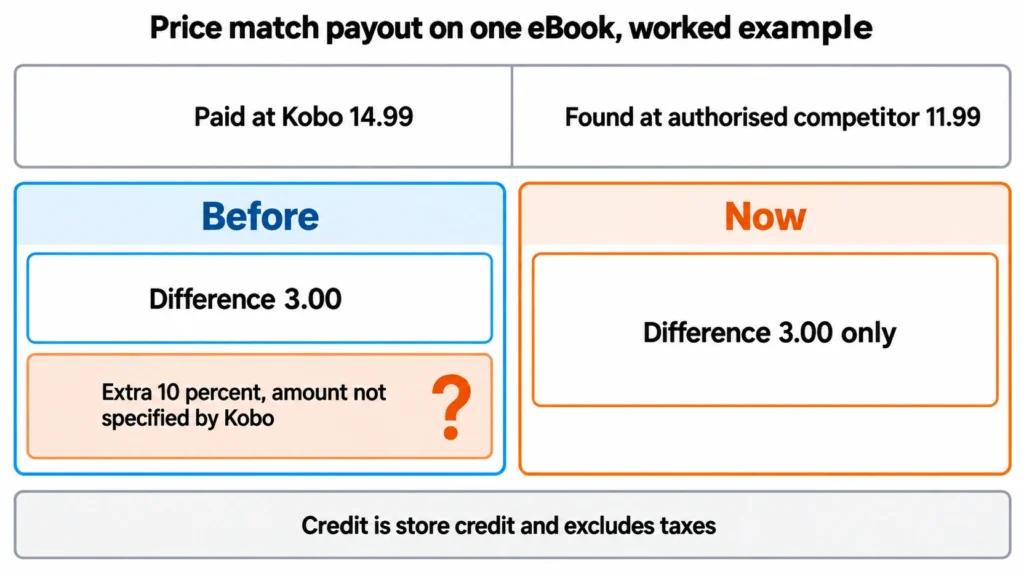
Work a simple case. Say you paid 14.99 for an eBook and then found the same ISBN at an authorised competitor in your country for 11.99, in the same currency. The formula now is plain:
credit = Kobo price – competitor price
That gives 3.00 in account credit, excluding taxes. Under the old policy you also received a further 10 percent. Kobo’s public pages never set out what that 10 percent applied to, so it is unclear whether it was 10 percent of the difference, which would have been 0.30, or 10 percent of the competitor’s price, which would have been 1.20. The gap between those two readings is large, and no current Kobo page resolves it.
What is certain is the direction. Every successful match from now on returns less than the same match returned a month ago.
Why the tax line matters more than it looks
Kobo’s page states that the credit excludes taxes. That single word carries real weight for readers in tax-adding markets, because the amount you were charged at checkout includes tax and the credit you get back does not.
So a match rarely restores you to the position of having bought at the lower price. It moves you closer. The old 10 percent used to close part of that remaining gap, and with the bonus removed, the shortfall sits entirely with the buyer. Anyone who price-matched as a routine habit will notice the difference across a year of buying.
What the guarantee does not cover
The published terms describe eBooks and audiobooks. Kobo’s price match page says nothing about matching prices on eReaders or accessories, so treat hardware as outside the scheme and shop for it on price and timing instead. If you are weighing up a device, our specification page for the Kobo Clara BW sets out the hardware side of that decision.
Pre-orders follow a separate track. Kobo covers them under its Pre-order Price Guarantee, and you can only request a price match for a pre-ordered title within 7 days following the book’s official on-sale date. That window runs from the release date. The day you placed the pre-order does not count, which catches people out.
Buying habits after the change
The practical advice shifts a little. Checking a competitor after every purchase used to carry a small built-in reward, because even a tiny price gap returned the difference plus a bonus. Now the return equals the gap exactly, minus tax, so the effort only pays on titles where the difference is real money.
Two habits still earn their keep. Check before you buy, since a lower competitor price is worth more as a purchase decision than as a credit request. And keep the 7 day clock in mind, because the guarantee expires quietly and Kobo does not remind you.