Onyx put the BOOX Palma 3 on its own store on September 15, 2026, and the listing still reads Available Soon. The page shows From $319.99, while the store data behind it lists $339.99 for the United States and $319.99 for Hong Kong. Early coverage read those two figures as a price cut. They are regional prices for the same device. This guide sets out exactly what Onyx has published about the Palma 3, what changed since the Palma 2, and which claims circulating this week the company’s own specification sheet does not support.
What Onyx has published
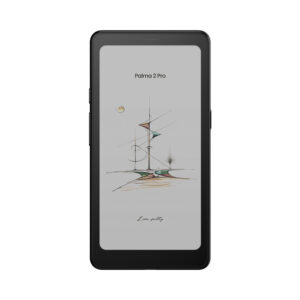
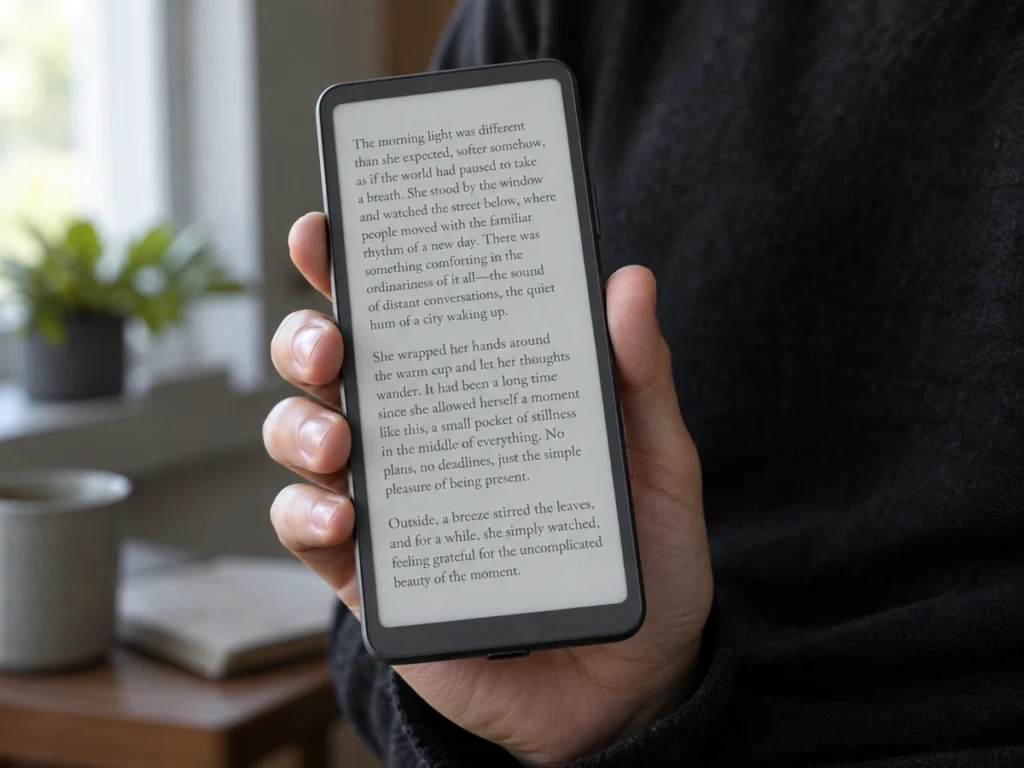
The Palma 3 keeps the phone-shaped format that made the line unusual. Onyx lists a 6.13 inch ePaper glass screen with a flat cover lens, a resolution of 824 by 1,648 and 300 pixels per inch. Inside sit an octa-core processor with BOOX Super Refresh technology, 6 GB of RAM and 128 GB of storage, plus a microSD slot. The store description adds that the chip is built on a 4 nm process and that Google Play ships on the device.
Connectivity runs to Wi-Fi and Bluetooth 6.0. The body measures 159 by 78 by 7.8 mm and weighs about 195 g. A 3,950 mAh battery sits behind a 16 MP rear camera with an LED flash. Onyx also lists a power button with fingerprint recognition, volume and page-turn buttons, a smart button, a USB-C port that doubles as an audio jack, a speaker and dual microphones. The software line reads Android 16.
The price, and why two numbers appear
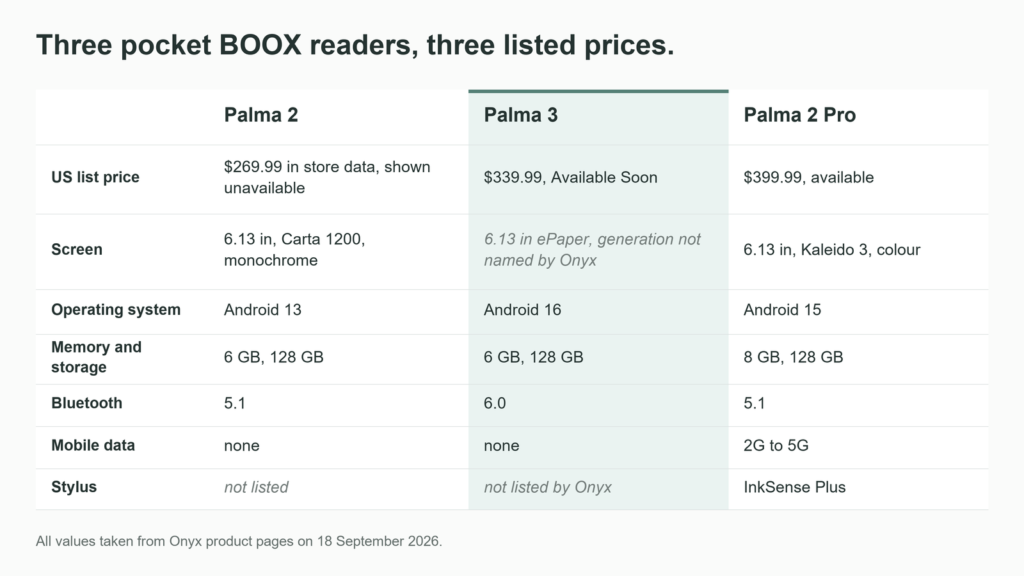
Onyx sells through one storefront with regional variants. The Palma 3 currently carries $339.99 for the United States and $319.99 for Hong Kong, and the product page displays the lower of the two as a From price. No discount is attached to either figure, and neither variant could be ordered on September 18, 2026.
Set that against the rest of the family. Onyx lists the Palma 2 Pro at $399.99 for the United States, and that model remains available. The Palma 2 is the awkward one. Onyx’s store data carries $269.99 for the United States while a comparison table on the Palma 2 product page still shows $249.99. The company’s own pages disagree, so treat any Palma 2 figure as unsettled, and do not use it to work out how much the Palma 3 went up.
Changes since the Palma 2
Put the two specification sheets side by side and the list of differences is shorter than the launch coverage implies.
| Specification | Palma 2 | Palma 3 |
|---|---|---|
| Screen | 6.13 in, 824 x 1648, 300 ppi | 6.13 in, 824 x 1648, 300 ppi |
| Operating system | Android 13 | Android 16 |
| Bluetooth | 5.1 | 6.0 |
| Memory and storage | 6 GB, 128 GB | 6 GB, 128 GB |
| Battery | 3,950 mAh | 3,950 mAh |
| Dimensions | 159 x 80 x 8.0 mm | 159 x 78 x 7.8 mm |
| Weight | about 170 g | about 195 g |
The screen resolution, pixel density, memory, storage, camera and battery capacity all carry over unchanged. Three years of Android versions, a newer Bluetooth radio and a slightly narrower, slightly thinner body make up the visible upgrade. The weight moved the other way, by 25 g.
The panel question Onyx has not answered
Several reports describe the Palma 3 as using an E Ink Carta 1300 screen. Onyx does not say so. The specification sheet reads only “6.13 inch HD ePaper glass screen with flat cover-lens”, and the marketing copy says “the latest-gen B&W ePaper technology with sharper contrast” without naming a generation.
That silence stands out because Onyx names panel generations elsewhere. The company describes the Palma 2 as a Carta 1200 device, and it describes the smaller Go 6 as a Carta 1300 device. You can compare the published hardware on our specification page for the BOOX Go 6, which sits in the same pocket class at 6 inches and does carry a named panel. Until Onyx prints a generation for the Palma 3, the Carta 1300 claim stays unconfirmed.
Stylus support needs the same caution
Reports this week said the Palma 3 adds stylus support. Onyx’s product page contains no reference to a stylus, a pen, handwriting or the InkSense accessory, and the box contents list only the device, a USB-C cable, a card tray tool, a quick start guide and a warranty card.
The company does sell a Palma with pen support, and it is the Palma 2 Pro. That model’s description names InkSense Plus stylus support directly, alongside a Kaleido 3 colour screen, Android 15, 8 GB of memory and support for 2G through 5G networks. Anyone buying a pocket BOOX specifically to write on it should look there, not at the Palma 3, at least until Onyx publishes something different.
Where the Palma 3 sits in the line
Three Palma models now share a storefront at three prices. The Palma 2 Pro at $399.99 is the colour, cellular, pen-capable one. The Palma 3 at $339.99 is monochrome, Wi-Fi only and the newest software. Onyx’s store shows every Palma 2 variant as unavailable, so the older model is not a live alternative for most buyers.
So the decision comes down to what you want the device to be. In my judgement, readers who want a distraction-light Android reader will prefer the Palma 3 mainly for its software age, because an Android 16 device starts its app-compatibility clock three versions later than an Android 13 one. Readers who want colour, a SIM or a pen have no reason to wait for it at all.
What to confirm before you order
Onyx has not announced a shipping date, and both regional variants show as unavailable. Watch for three things when that changes. First, a named panel generation on the specification page, which settles the Carta 1300 question. Second, the United States price at launch, since the listed $339.99 is a pre-release figure and pre-release figures move. Third, whether the device reaches Onyx’s Amazon storefront, because that route usually decides how quickly buyers outside Asia can get one.
One more point deserves attention from anyone upgrading. The Palma 3 is 25 g heavier than the Palma 2 while keeping the same battery capacity, the same screen and the same memory. The added mass comes from the redesigned body, so nobody should expect longer runtime from the newer model.