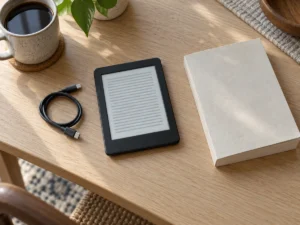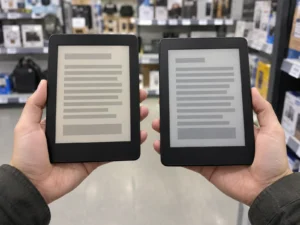
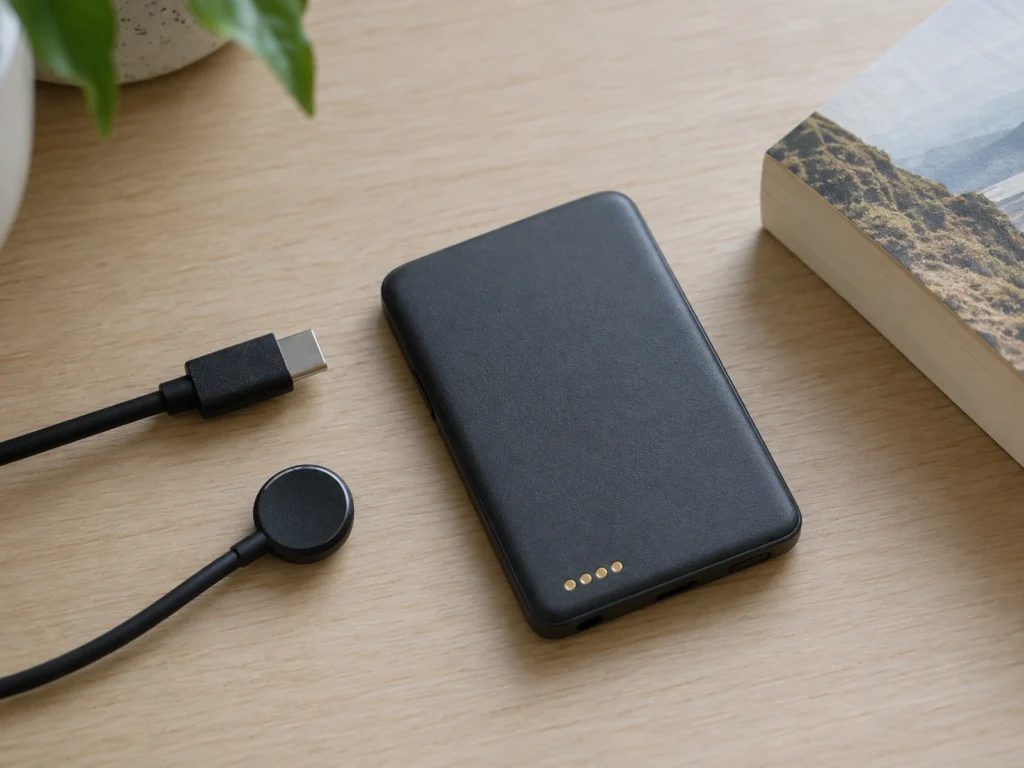
A charging port rarely decides a purchase. It did this month. XTEINK, a small maker of pocket-sized E Ink readers, removed the USB-C port from its cheapest model and replaced it with magnetic pogo pins. Buyers pushed back hard enough that the company reversed course in public on 10 September 2026 and said USB-C is coming back. The argument is worth following even if you will never buy an XTEINK, because e-reader USB-C is not only a preference. A European rule names the category directly.
What XTEINK said, and when
The X4 Classic went on sale at 79 dollars on the company’s own site in early September 2026, and reached XTEINK’s Amazon storefront on 12 September, initially in one colour. It charges through a magnetic pogo connection.
That was not a one-off. XTEINK had already moved the smaller X3 and the newer X4 Pro to pogo pins, so by the time the X4 Classic launched, no current XTEINK model carried USB-C at all. The company founder posted an explanation on Reddit, saying the change let the readers be thinner and lighter. Complaints kept growing.
On 10 September the company published an update that reads, in part: some of you really value having the thinnest and lightest device possible, while others would rather accept a little more thickness for USB-C and a more convenient everyday experience. It added that not everyone should have to make the same trade-off. In plain terms, XTEINK plans to offer both. No model names, no dates and no pricing came with that statement.
Inside the X4 Classic
The device explains why weight mattered so much to its designers. It has a 4.3-inch E Ink screen, weighs roughly 68 grams, and drops both the touchscreen and the front light. Navigation runs through front and side buttons, and a shake gesture turns pages for one-handed reading, which you can switch off. Inside sit an ESP32-S3 processor and a 920 mAh battery, with 16 GB of storage and a microSD slot. It reads EPUB, TXT, MOBI and PDF, and it carries Wi-Fi and Bluetooth.
At 68 grams this is a different class of object from a Kindle or a Kobo. Shaving a millimetre and a few grams is a real design goal at that size, and a USB-C receptacle is one of the thicker components in a very thin shell. So the engineering argument was not invented after the fact.
What the EU charger rule says about e-readers
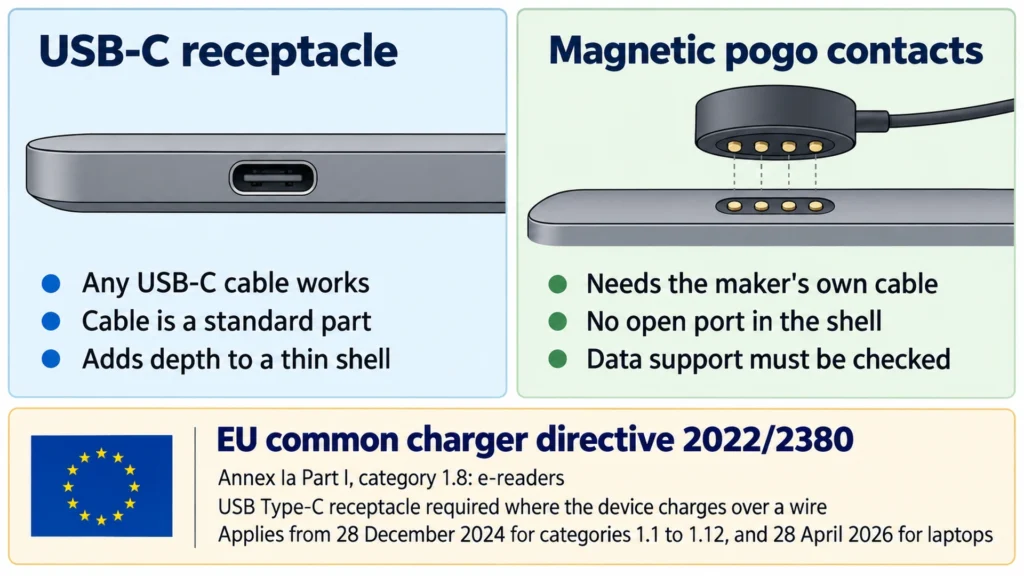
Here the story stops being a preference argument. Directive (EU) 2022/2380, the common charger directive, lists thirteen categories of radio equipment in Part I of Annex Ia. Category 1.8 is e-readers, sitting between portable speakers and keyboards.
For every listed category, the requirement is to be equipped with the USB Type-C receptacle, as described in the standard EN IEC 62680-1-3:2021, in so far as the equipment is capable of being recharged by means of wired charging. Devices drawing more than 5 volts, 3 amperes or 15 watts must also support USB Power Delivery, which no 920 mAh e-reader will approach.
Two dates matter. The rules applied from 28 December 2024 for categories 1.1 to 1.12, which includes e-readers, and from 28 April 2026 for laptops. A separate obligation requires sellers to let buyers acquire the device without a charging brick.
The text carries no exemption for products too small to house the port. A device either charges over a wire or it does not, and if it does, the receptacle must be USB Type-C.
Where that leaves a pogo-pin reader
Magnetic pogo charging is wired charging. Current travels down a cable to metal contacts. So a pogo-only e-reader placed on the European market would run straight into the requirement above.
XTEINK has not said whether it places these models on the EU market through an authorised route. Small brands frequently sell worldwide through their own web shops and marketplace listings, and the directive binds equipment placed on the EU market rather than a device someone imports privately for personal use. Enforcement also sits with national market surveillance authorities, so the picture varies by country. What is clear is that the rule names e-readers, that it has applied since December 2024, and that a proprietary charging contact does not sit comfortably inside it.
The cost of a proprietary connector
Three practical costs show up quickly. The cable becomes a single-supplier part, so losing it on a trip means waiting for a replacement from one shop. A USB-C cable could be borrowed from anybody in the room. Travel gets heavier in the small way that matters, because one more cable joins the bag. Resale and long-term support depend on that supplier continuing to sell the accessory years later.
Data is the open question. A pogo connection can carry data, yet it does not have to, and sideloading an EPUB over a cable is how many people load books onto a cheap reader. Published material does not say whether the X4 Classic’s contacts pass data as well as power, and it is the first thing to ask a seller before buying.
Where pogo pins help
The honest case for pogo pins is short but not empty. Removing a receptacle frees internal depth in a device where depth is the product. A sealed shell with exposed contacts is also simpler to protect against dust and splashes than an open port, although XTEINK has not published an ingress rating. Magnetic attachment suits a reader you keep clipping to a backplate.
Weigh those against a cable you already own. For most buyers that comparison ends quickly, which is roughly what XTEINK heard.
Questions to ask before buying a cheap e-reader
Ask four questions. Does it charge over USB-C, and if not, what exactly ships in the box? Does the charging connection also transfer files, or does sideloading depend on Wi-Fi? Is a replacement cable sold separately, and at what price? Does the device reach you through a seller inside your own market, which is what determines whether local consumer rules apply?
If the answers get vague, a mainstream compact reader removes the question entirely. Something like the BOOX Go 7 charges over standard USB-C and takes any cable you already carry, at a higher price and a higher weight.
Why a charging port made the news
A 79 dollar reader with no front light and no touchscreen is a niche product, and its connector would normally be a footnote. It became news because the industry spent a decade converging on one port, and buyers now treat that as settled. Regulation in Europe agrees with them, and for e-readers it has agreed since December 2024. XTEINK’s reversal suggests the market reached the same conclusion without waiting to be told.