The Association of American Publishers released its June 2026 StatShot report on 9 September 2026, and one line in it has been picked up everywhere. US e-book sales revenue fell 0.3 percent for the month, to 86.4 million dollars, while downloaded audio revenue rose 3.9 percent to 97.4 million dollars. Audio out-earned e-books again. That sounds like a verdict on e-readers, and it mostly is not. What follows is what the report measures, what the gap looks like in proportion, and how much of it should change your thinking if you are about to buy a device.
What the report says
June 2026 was a strong month for publishers overall. Total reported revenue across all categories reached 936.3 million dollars, up 11.0 percent against June 2025. Trade, which covers consumer books, came in at 765.1 million dollars, up 12.1 percent.
Print did the heavy lifting. Hardback revenue rose 14.5 percent to 243.6 million dollars, and paperback rose 18.2 percent to 292.2 million dollars. Against that backdrop, a 0.3 percent dip in e-books is not a collapse. It is a flat month sitting inside a growing one.
The gap between the two digital formats
Downloaded audio brought in 97.4 million dollars in June against 86.4 million for e-books, so audio was about 13 percent larger. Across the year so far the pattern is wider. Digital audio has reached 597.8 million dollars, up 12.6 percent, while e-books sit at 516.1 million dollars, down 3.0 percent.
That is a difference of 81.7 million dollars year to date, and the direction of travel matters more than the size. One format is growing at a double-digit rate. The other is drifting slightly downward.
Put it in proportion before you panic
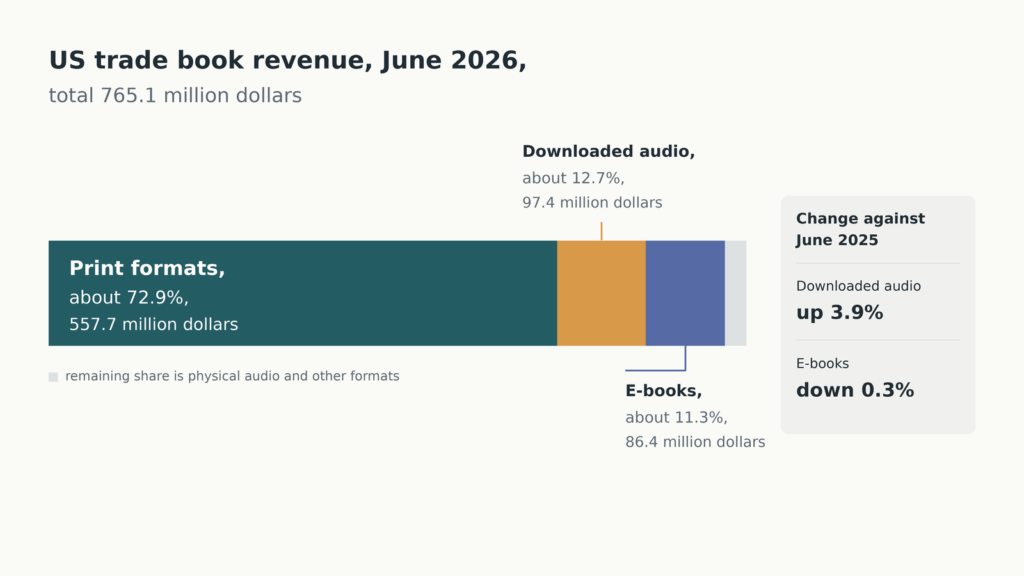
Share of trade revenue is the useful calculation. Divide 86.4 by 765.1 and e-books accounted for about 11.3 percent of June trade revenue, while digital audio took about 12.7 percent. Add them and digital formats made up roughly 24 percent of the month.
Print took the other three quarters, at about 72.9 percent once hardback, paperback, mass market and special bindings are combined. So the honest summary is that both digital formats remain minority formats, and the one that shrank slightly is still a very large business.
Revenue is not the same as reading
Here is the caveat that most coverage skips. StatShot measures money reported by participating publishers, not the number of books people read. E-book pricing and audiobook pricing behave very differently, and an audiobook usually carries a much higher price than the same title in e-book form.
So a larger revenue figure does not prove that more people listened than read. The report does not publish unit volumes. Flat e-book revenue paired with lower average prices could even mean more copies moved, and the data as published cannot settle that question either way.
Self-publishing, subscriptions and library loans
Self-published titles are largely outside these figures, and that omission matters more for e-books than for any other format. Subscription reading programmes also account for revenue in ways that do not map neatly onto a per-copy sale.
Library borrowing sits outside it too. When you borrow an e-book through a public library app, the money moved earlier, when the library bought the licence. A reader who borrows heavily contributes almost nothing to the monthly line and still reads constantly.
Does this change what device you should buy
Not by itself. An 11 percent share of a multi-billion dollar market keeps every major e-book store commercially healthy, and nothing in this report suggests that Kindle or Kobo catalogues are at risk.
What it does suggest is that a growing number of readers use both formats in the same week. That makes the audio side of an e-reader worth checking, and this is where the hardware differences get awkward.
The audio hardware gap on e-readers
Most current e-readers list audiobook support, and the phrase hides a wide range of experiences. Some devices have no speaker and no headphone socket at all, so listening means pairing Bluetooth headphones every single time.
The Kobo Clara BW is a clear example of the pattern. It advertises audiobook support and it has Bluetooth, yet there is no speaker and no jack in the hardware, so the feature is real but awkward in daily use. Check that specific detail before you buy, because a spec sheet that says audiobook support tells you almost nothing about how it feels to use.
Store lock-in matters here as well. Audiobook libraries are tied to the store you bought them from, and moving between platforms is harder for audio than for e-books.
What to watch over the next few months
One month proves very little, and 0.3 percent is well inside the range that normal release scheduling can produce. The year-to-date figures carry more weight, and there the 3.0 percent e-book decline against a 12.6 percent audio rise is a real trend.
Watch whether that gap keeps widening through the autumn release season. If audio keeps growing at double digits while e-books hold flat, the practical consequence for buyers is simple. Devices that handle both formats well will be worth more than devices that treat listening as a checkbox.